Showing posts sorted by relevance for query "cashless society". Sort by date Show all posts

Friday, June 10, 2016

Cashless Society Update - 06.10.2016


The Shift to a Cashless Society is Snowballing
JEFF DESJARDINS on May 17, 2016 at 12:15 pm

The Shift to a Cashless Society is Snowballing

Large Version of the image above: http://2oqz471sa19h3vbwa53m33yj.wpengine.netdna-cdn.com/wp-content/uploads/2016/05/war-on-cash.jpg

The Shift to a Cashless Society is Snowballing

Love it or hate it, cash is playing an increasingly less important role in society.

In some ways this is great news for consumers. The rise of mobile and electronic payments means faster, convenient, and more efficient purchases in most instances. New technologies are being built and improved to facilitate these transactions, and improving security is also a priority for many payment providers.

However, there is also a darker side in the shift to a cashless society. Governments and central banks have a different rationale behind the elimination of cash transactions, and as a result, the so-called “war on cash” is on.

ON THE PATH TO A CASHLESS SOCIETY

The Federal Reserve estimates that there will be $616.9 billion in cashless transactions in 2016. That’s up from around $60 billion in 2010.

Despite the magnitude of this overall shift, what is happening from country to country varies quite considerably. Consider the contradicting evidence between Sweden and Germany.

In Sweden, about 59% of all consumer transactions are cashless, and hard currency makes up just 2% of the economy. Yet, across the Baltic Sea, Germans are far bigger proponents of modern cash. This should not be too surprising, considering that the German words for “debt” and “guilt” are the exact same.

Within Germany, only 33% of consumer transactions are cashless, and there are only 0.06 credit cards in existence per person.

THE DARK SIDE OF CASHLESS

The shift to a cashless society is even gaining momentum in Germany, but it is not because of the willing adoption from the general public. According to Handelsblatt, a leading German business newspaper, a proposal to eliminate the €500 note while capping all cash transactions at €5,000 was made in February by the junior partner of the coalition government.

Governments have been increasingly pushing for a cashless society. Ostensibly, by having a paper trail for all transactions, such a move would decrease crime, money laundering, and tax evasion. France’s finance minister recently stated that he would “fight against the use of cash and anonymity in the French economy” in order to prevent terrorism and other threats. Meanwhile, former Secretary of the Treasury and economist Larry Summers has called for scrapping the U.S. $100 bill – the most widely used currency note in the world.

“SMOOTHER” AGGREGATE DEMAND?

It’s not simply an argument of the above government rationale versus that of privacy and anonymity. Perhaps the least talked-about implication of a cashless society is the way that it could potentially empower central banking to have more ammunition in “smoothing” out the way people save and spend money.

By eliminating the prospect of cash savings, monetary policy options like negative interest rates would be much more effective if implemented. All money would presumably be stored under the same banking system umbrella, and even the most prudent savers could be taxed with negative rates to encourage consumer spending.

While there are certainly benefits to using digital payments, our view is that going digital should be an individual consumer choice that can be based on personal benefits and drawbacks. People should have the voluntary choice of going plastic or using apps for payment, but they shouldn’t be pushed into either option unwillingly.

Forced banishment of cash is a completely different thing, and we should be increasingly wary and suspicious of the real rationale behind such a scheme.

http://www.visualcapitalist.com/shift-cashless-society-snowballing/

=========================================================================

How will the homeless survive in a cashless society?
Toby Meyjes for Metro.co.uk Friday 10 Jun 2016 4:47 pm

How will the homeless survive in a cashless society?

In less than ten years time it is estimated that only one in four payments will made by cash.

Although it might feel to some like we have reached that point already, it will mark a dramatic shift from the current status quo when around half of all payments are made by notes or coins.

But while the shift to a cash free existence might feel like an inevitability, there are people on the fringes of society who are so reliant on it, that a life without it almost seems like an impossibility.

Yet, there is a growing awareness amongst the homeless and those that support them that action needs to be taken now so they are ready when the time comes.

For those with no fixed abode there are a huge array of different hurdles that need to be jumped in order for them live a life not wholly reliant on cash.

Take setting up a bank account, for instance.

It seems tough enough when you have a permanent address, proof of other credit facilities and ID.

But when you don’t it becomes a whole lot harder.

And that is why charities like St Mungo’s and the Big Issue Foundation (the charitable arm of the Big Issue) are working hard to help as many people as possible gain access to the things we take for granted.

Around one in four of St Mungo’s clients dont have a bank account, many having only dealt with cash before.

read more here:
http://metro.co.uk/2016/06/10/how-will-the-homeless-survive-in-a-cashless-society-5936662/

=========================================================================

Sweden leads the race to become cashless society
Swedes are blazing a trail in Europe, with banks, buses, street vendors and even churches expecting plastic or virtual payment

Jon Henley
Saturday 4 June 2016 11.00 EDT
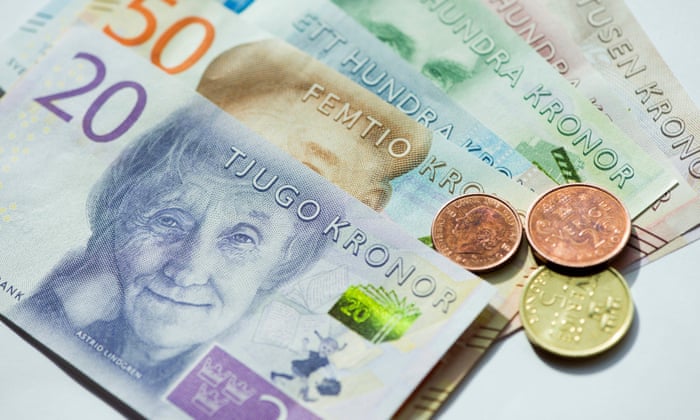


In 1661, Stockholms Banco, the precursor to the Swedish central bank, issued Europe’s first banknotes, on thick watermarked paper bearing the bank’s seal and eight handwritten signatures.

Last year – as Britain did last week – Sweden launched a new series of notes, cheery affairs featuring 20th-century Swedish cultural giants such as Astrid Lindgren, the creator of Pippi Longstocking, Greta Garbo and filmmaker Ingmar Bergman. But like its Nordic neighbours Norway, Denmark and Finland, Sweden is fast becoming an almost entirely cashless society.

“I don’t use cash any more, for anything,” said Louise Henriksson, 26, a teaching assistant. “You just don’t need it. Shops don’t want it; lots of banks don’t even have it. Even for a candy bar or a paper, you use a card or phone.”

Swedish buses have not taken cash for years, it is impossible to buy a ticket on the Stockholm metro with cash, retailers are legally entitled to refuse coins and notes, and street vendors – and even churches – increasingly prefer card or phone payments.

According to central bank the Riksbank, cash transactions made up barely 2% of the value of all payments made in Sweden last year – a figure some see dropping to 0.5% by 2020. In shops, cash is now used for barely 20% of transactions, half the number five years ago, and way below the global average of 75%.

And astonishingly, about 900 of Sweden’s 1,600 bank branches no longer keep cash on hand or take cash deposits – and many, especially in rural areas, no longer have ATMs. Circulation of Swedish krona has fallen from around 106bn in 2009 to 80bn last year.

“I think, in practice, Sweden will pretty much be a cashless society within about five years,”
said Niklas Arvidsson, an associate professor specialising in payment systems innovation at Stockholm’s Royal Institute of Technology (KTH).

more here:
https://www.theguardian.com/business/2016/jun/04/sweden-cashless-society-cards-phone-apps-leading-europe

=========================================================================

A last hurrah for banknotes as UK switches to mobile and card payment
With the launch of the new plastic fiver, Patrick Collinson looks at changing payment methods and asks if Britain is ready to become a cashless society

Patrick Collinson
Saturday 4 June 2016 11.00 EDT
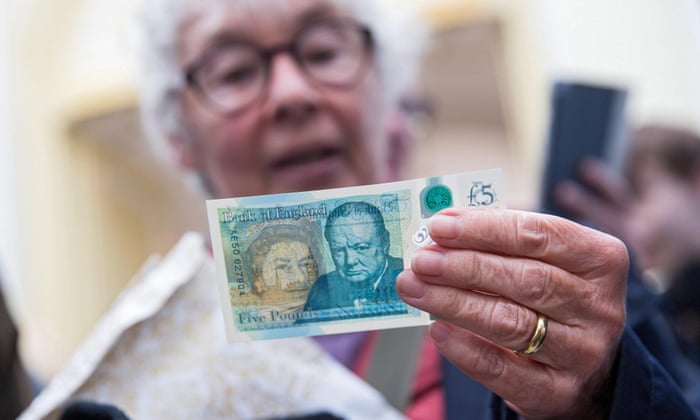


Winston Churchill gazes out from one side of the new £5 plastic note, the Queen from the other. But the chances of Prince William appearing on a banknote are looking slim. More than 300 years after the first Bank of England banknotes appeared, the new plastic ones could perhaps be the last.

Stop a young adult on a British high street and you will find that one in eight has not a penny in cash on them. Even the ones who do are likely to have no more than £20. For them, the cashless society is not tomorrow’s world, but today’s: a contactless card flashed to enter the tube; a smartphone tapped at Pret for a lunchtime sandwich; another card waved at a Tesco Express on the way home; the cab journey back from the pub processed by Uber.

Who needs banknotes? According to a survey by payments company Worldpay, six out of 10 young adults would prefer not to use cash at all.

When Transport for London banned cash on the buses in mid-2014, it was greeted with a backlash from some quarters; “passenger fury” said one headline, “ban hits the vulnerable” was another. Yet, two years on, behaviour has adjusted. TfL says it has saved £24m in cash-handling costs, and queues have improved.

The cashless society has been long mooted, but only now is it arriving. A 1996 trial in Swindon to encourage the town’s 150,000-plus people to use “electronic purses” flopped through lack of interest. But contactless cards – there are now more than 36m in Britain’s wallets – and more recently Apple Pay and Android Pay, have dramatically accelerated the switch away from cash.

Crucially, it has been the readiness of big retailers to accept “tap-and-go” technology for small-value items, with Tesco and TfL at the forefront, that has spurred the revolution. Monthly spending on contactless cards is now running at around £1.5bn, or three times the level of just a year ago.

Technology experts see contactless payment as just a stepping stone to the cashless society, with smartphones becoming the main way to pay. Since the launch of Apple Pay in July last year, 8 million journeys on London Underground have been paid for by iPhone users tapping their handset at entry and exit points. Meanwhile, Google’s rival, Android Pay, was launched last month. Unlike contactless cards, where spending is capped at £30, Apple and Android users can spend more freely, although they may have to authenticate with a Pin or fingerprint.

more here:
https://www.theguardian.com/business/2016/jun/04/uk-switch-to-cashless-society-contactless-payment

=========================================================================

The Countries That Would Profit Most from a Cashless World
Bhaskar ChakravortiRavi Shankar ChaturvediBenjamin Mazzotta
MAY 31, 2016

It’s been nearly 300 years since paper money became accepted as legal tender. While much has changed about how we make, sell, and buy goods, cash has stuck around. It’s been only recently that the road to a wider cashless society has started to really take shape. From apps such as PayPal, Venmo, or Square Cash to mobile payment platforms like Kenya’s mPesa, Bangladesh’s bKash, or Apple Pay, there are signs that cash is following the path of other “information goods,” such as printed photographs, cassette tapes, and DVDs in being replaced by digital alternatives.

Or as Samantha Bee, host of the show Full Frontal, put it recently: “I’d like to talk a little bit about money. For those of you who haven’t heard of it, it’s like Venmo for old people.”

But all of this may still leave us with a question – if cash isn’t inherently broken, why fix it?

Policy makers and economists, such as Harvard’s Ken Rogoff, have made elegant arguments for the benefits of a cashless society. Economic uncertainty around the globe has raised concerns that consumers could take cash out of banks – especially in negative interest rate envrionments — and hoard it. Eliminating cash is one way to reduce that risk. Denmark, Sweden, and Norway are already considering it, while the European Central Bank is considering getting rid of large-denomination bills.

Cash, according to a recent MasterCard study, accounts for nearly 85% of global consumer transactions. Cash has stubbornly resisted going the way of digital extinction. Paper currency is ubiquitous. It is also untraceable and universally accepted (except in some circumstances, usually involving very large payments). For many users, cash equates to a sense of security and for many it is a sense of independence from government oversight. The rise of cyber-crime and growing concerns about the ability of public agencies to look through digital records will add to the unwillingness among many to let go of paper money.

The migration to a cashless society is far from being either uniform or universal. Whereas most Swedes are embracing a cashless future, along with an unlikely peer group, that includes both Somaliland and South Korea, some of Sweden’s neighbors, in response to EU’s increasing regulations on restricting cash usage, are demanding a “constitutional right to pay in cash” fueled by concerns around negative interest rates and a perceived loss of privacy that comes with digital money.

more here:
https://hbr.org/2016/05/the-countries-that-would-profit-most-from-a-cashless-world

=========================================================================

-Spyda

Wednesday, September 10, 2014

Apple Pay, another step towards Cashless Society

Apple just debuted the the next step towards The Mark, at least their implementation of it.

I've mentioned before in the past that Apple will be the company to push technology into the Future.

===============================================

How Apple Is Invading Our Bodies

Apple Watch Cover

Lev Grossman @leverus  Matt Vella @mattvella  1:33 PM ET

The Silicon Valley giant has redrawn the line that separates our technology and ourselves. That may not be a good thing

With the unveiling of the Apple Watch Tuesday in Cupertino, California, Apple is attempting to put technology somewhere where it’s never been particularly welcome. Like a pushy date, the Apple Watch wants to get intimate with us in a way we’re not entirely used to or prepared for. This isn’t just a new product, this is technology attempting to colonize our bodies.

The Apple Watch is very personal—“personal” and “intimate” were words that Apple CEO Tim Cook and his colleagues used over and over again when presenting it to the public for the first time. That’s where the watch is likely to change things, because it does something computers aren’t generally supposed to: it lives on your body. It perches on your wrist, like one of Cinderella’s helpful bluebirds. It gets closer than we’re used technology getting. It gets inside your personal bubble. We’re used to technology being safely Other, but the Apple Watch wants to snuggle up and become part of your Self.

This is new, and slightly unnerving. When technologies get adopted as fast as we tend to adopt Apple’s products, there are always unintended consequences. When the iPhone came out it was praised to the skies as a design and engineering marvel, because it is one, but no one really understood what it would be like to have it in our lives. Nobody anticipated the way iPhones exert a constant gravitational tug on our attention. Do I have e-mail? What’s happening on Twitter? Could I get away with playing Tiny Wings at this meeting? When you’re carrying a smartphone, your attention is never entirely undivided.

The reality of living with an iPhone, or any smart, connected device, is that it makes reality feel just that little bit less real. One gets over-connected, to the point where the thoughts and opinions of distant anonymous strangers start to feel more urgent than those of your loved ones who are in the same room as you. One forgets how to be alone and undistracted. Ironically enough experiences don’t feel fully real till you’ve used your phone to make them virtual—tweeted them or tumbled them or Instagrammed them or YouTubed them, and the world has congratulated you for doing so. Smartphones create needs we never had before, and were probably better off without.

read more here:
http://time.com/3318655/apple-watch-2/


===============================================

WILL APPLE PAY CONVINCE YOU TO LEAVE YOUR WALLET AT HOME?

Eddy Cue, Apple Senior Vice President of Internet Software and Services, discusses the new Apple Pay product.
Eddy Cue, Apple Senior Vice President of Internet Software and Services, discusses the new Apple Pay product. // Marcio Jose Sanchez/AP

Apple announced its mobile payment service — called Apple Pay — Tuesday, effectively sending shivers down the metaphorical spines of competitors like Coin, Google Wallet, and Softcard.

But what is Apple Pay? Apple's Eddy Cue pretty much covered it during the (painfully) slow intro video: Instead of wasting your precious time rummaging around for your credit card, why not use your phone — which probably never leaves your hand — to digitally pay with a single tap instead?

Apple Pay, though, isn't the first service to command your credit cards. Here's how it stacks up against other wallet eradicators.

Apple Pay

What It Does: By using NFC (near-field communication) technology, the service will store credit cards (Visa, Mastercard, and American Express) and encrypt each transaction made at participating stores using receivers for devices with Apple Pay.

Why It's Cool: It eliminates the wallet and will certainly speed up the process — even if the process doesn't take that long in the first place. Either way, it takes away the middleman at a slew of stores already, including Subway, Disney, Walgreens, Macy's, Sephora, and more.

Why It's Not So Cool: Three major questions remain: A) Do we really need it? B) When your phone runs out of battery, will you end up needing your physical cards anyway? and C) Do we want to put all our credit card information into one device, given privacy concerns running rampant already over services like the iCloud? Tim Cook says it's all the more reason you'll need Apple Pay: "We're totally reliant on the exposed numbers, and the outdated and vulnerable magnetic interface — which by the way is five decades old — and the security codes which all of us know aren't secure," he said on stage, showing off the Touch ID confirmation feature required to carry out a transaction.

the alternatives and more, here:
http://www.nextgov.com/mobile/2014/09/will-apple-pay-convince-you-leave-your-wallet-home/93671/

===============================================

Cashless Society Update:

5 reasons Apple is poised to finally usher in a cashless society
BY TRICIA DURYEE on September 8, 2014 at 4:54 pm

BookBook is an iPhone case and wallet all in one.

A endless list of companies — from wireless carriers and handset makers to tech giants as big as Google — have tried to muscle their way into the mobile payments market, by releasing clunky ways to get consumers to pay for their groceries or a movie ticket with a swipe of their phone.

Now the speculation is that Apple is gearing up to take a shot at building a better mobile wallet. Expectations are high for the Cupertino, Calf.-based company. The prevailing thought is that Apple’s mobile wallet will be the first to take off thanks to the company’s ability to develop elegant and easy-to-use services that appeal to a wide audience.

So, if the rumors are true, and Apple does roll out a mobile payments platform tomorrow, we’ve come up with five reasons why Apple will be one of the major factors in changing the way we pay.

1. Apple has been laying the groundwork for years
2. Apple controls both the hardware and the software, so it can make the right technology choices.
3. Apple is already a payments kingpin
4. Mobile payments are on Apple CEO Tim Cook’s radar
5. Apple will succeed because everyone wants it to


the details here:
http://www.geekwire.com/2014/five-signs-apple-will-successful-ushering-cashless-society/

===============================================

Are We Becoming A Cashless Society?
August 21, 2014 6:55 AM

(Photo illustration by Ed Fischer)

By Hadas Kuznits
PHILADELPHIA (CBS) – Could America be turning into a cashless society?

Folks tell KYW Newsradio when it comes to their purchases, they’re using less green and more plastic:

“I mostly spend credit.”

“I don’t carry cash at all, I always sue my debit card.”

“I don’t carry cash on me.”

So why the switch from cash to credit?

“I don’t know, I guess probably because it’s easier to carry around.”

“Well, maybe you can get robbed.”

“Like change, you don’t have to jingle it in your pockets and your purse isn’t as heavy.”


This woman says while she’s not a fan of a cashless society, she accepts that many want to pay using credit:

“That hurts us as business owners every time because we get charged for every transaction but it’s the way of the world and if we don’t use it then we don’t make that money.”

Many people seem to agree, they’ve especially noticed the younger generation using less and less cash over the years:

“Yes, eventually I see it — I think my children everything is going to be debit cards and they’re gonna be like, ‘mom, can you put money on my card?’ Not, ‘mommy can I have money?’ (laughs) they’re gonna say, mommy can you put it on my debit card — they’re not even gonna call you anymore!  They’re gonna text you!”

here:
http://philadelphia.cbslocal.com/2014/08/21/are-we-becoming-a-cashless-society/

===============================================

Survey Shows Shift Towards Cashless Society Driven By Millennials
September 1, 2014 3:54 PM

Credit cards. (DAMIEN MEYER/AFP/Getty Images)

Jeff Bell

SAN FRANCISCO (KCBS)— When it comes to making small purchases, Americans prefer cash over plastic, but according to a new survey that’s likely to change.

“We are moving towards becoming a more cashless society,” said Creditcards.com Senior Industry Analyst Matt Schulz “Two-thirds of American card holders still use cash for purchases under $5.”

Age plays an important factor in what we prefer. For those who are over 50, they tend to use cash more than plastic.

“77-percent of people aged 50 or older use cash, but that number drops to only 52 percent for those who are younger than 50,”
Schulz said.

18 to 29 year-olds actually prefer plastic for purchases of less than $5.

Schulz said technology has something to do with these age-based preferences. “The younger generation is a little more used to buying things online, using plastic,” he said.

Americans also have strong preferences when it comes to using debit versus credit. He said generally people prefer debit to credit at about a 2 to 1 ratio. For millennials that ratio grows to about a 3 to 1 ratio.

cashless society - 05.09.2014
http://globalistnews.blogspot.com/2014/05/cashless-society-05092014.html

================================================

Is this 'The Mark"?

No

It's just another step in conditioning the masses to accepting the cashless society which will eventually lead to The Mark of the Beast.

People are going to be trained to tap their wrist watch near another device for scanning, to make payments for everyday things.

Think about that for a moment.

cashless society - 05.09.2014
http://globalistnews.blogspot.com/2014/05/cashless-society-05092014.html

cashless society update - 07.07.2014
http://globalistnews.blogspot.com/2014/07/cashless-society-update-07072014.html

cashless society update - 05.20.2013
http://globalistnews.blogspot.com/2014/05/cashless-society-update-05202013.html

Cashless Society Update - 06.21.2014
http://globalistnews.blogspot.com/2014/06/cashless-society-update-06212014.html

================================================

UPDATE:

2:03 pm ET
Feb 6, 2014
By  TOM GARA
October 2015: The End of the Swipe-and-Sign Credit Card


(We have corrected this article to reflect the fact that customers will still be able to sign for credit card payments after October 2015.)

It’s a payment ritual as familiar as handing over a $20 bill, and it’s soon to go extinct: prepare to say farewell to the swipe-and-sign of a credit card transaction.

Beginning later next year, you will stop swiping the credit card. Instead, you will insert your card into a slot, just like people do in much of the rest of the world, where the machine will read a microchip, not a magnetic stripe. You’ll still be signing for the time being, but the new system also enables the use of PIN numbers, if card issuers decide to add them to their cards.

The U.S. is the last major market to still use the old-fashioned swipe-and-sign system, and it’s a big reason why almost half the world’s credit card fraud happens in America, despite the country being home to about a quarter of all credit card transactions.

The recent large-scale theft of credit card data from retailers including Target and Neiman Marcus brought the issue more mainstream attention, leading to a Senate Judiciary Committee hearing this week. Executives told the senators that once the country transitions to the new system — which includes credit cards embedded with a microchip containing security data — these kind of hacking attacks will be much more difficult to pull off.

The shift is coming though: both MasterCard MA -0.53% and Visa V +0.35% have roadmaps for the changeover, and both have set October, 2015 as an important deadline in the switch. But why has it taken this long, and how will the changeover work for card users and businesses?

We spoke with MasterCard’s Carolyn Balfany, the company’s expert on all things related to the new payment system, known as EMV, that will lead to the end of the swipe-and-sign and the beginning of the chip-and-PIN. Here’s what she had to say.

more here:
http://blogs.wsj.com/corporate-intelligence/2014/02/06/october-2015-the-end-of-the-swipe-and-sign-credit-card/

and here:

Why Apple Pay could succeed where others have had underwhelming results
Not because Apple is a huge and influential company, but because the timing is right.
by Megan Geuss - Sept 14 2014, 1:00pm CDT


"Apple Pay beta"

A couple of months ago I was visiting New York City and had to catch an early flight out of LaGuardia. At 4:30am I hailed a taxi on Houston Street and the driver and I sped to the airport over dark, empty streets.

On the way, I found a Samsung Note 3 in my bag that Review Editor Ron Amadeo had sent me a few weeks before. The thing had a Near-Field Communications (NFC) chip in it, and I had set up my Google Wallet account on it earlier. I also noticed that the taxi I was in had a tap-to-pay terminal displayed in the backseat. I am a consummate morning person, and a rush of new-day adrenaline told me that it was time to make my first Google Wallet purchase in three years—my last one occurring in 2011 when I reviewed the service at its debut for PCWorld.

As we pulled up to the curb, the driver continued to ignore me as I got out my phone. I touched the Note 3 to the terminal. The phone vibrated, but nothing happened. At this point, the driver turned around. I gave an embarrassed laugh and he said a few polite words but he had no idea how to help me. “Nobody ever uses their phone to pay,” he said. I tried again. Nothing. But the driver was curious now, and maybe because it was so early in the morning and he had nothing else going on, he got out of the taxi and came around to my side.

“Maybe you should select Debit from the screen first,” he suggested. I selected debit and re-tried the phone. Nothing. But there appeared a screen that asked me to select a tip amount. I chose 20 percent and held the phone back up to the NFC reader. It vibrated and finally on the phone’s screen I got a notice of success. Success!

more here:
http://arstechnica.com/apple/2014/09/why-apple-pay-could-succeed-where-others-have-had-underwhelming-results/


Monday, July 7, 2014

cashless society update - 07.07.2014

Is a cashless society on the cards?
By Tara Kelly and Katie Pisa, for CNN
July 3, 2014 -- Updated 0921 GMT (1721 HKT


larger image, here:
http://edition.cnn.com/2014/07/02/business/is-a-cashless-society-on-the-cards/

===============================================

7 JULY 2014 - 8:14AM UPDATED | POSTED BY JOHN GLENDAY | 0 COMMENTS
London buses drive cashless society closer

Anyone looking to hail a London bus with a pocket full of small change is in for a disappointment from today after Transport for London (TfL) moved to make the service entirely cashless.

The switch means only passengers with a valid Oyster card, pre-paid ticket or contactless payment card will be able to hop onto one of the iconic red double decker’s, an initiative geared toward improving travel times.

TfL cites falling customer demand for notes and coins as fueling the change with surveys showing that as many as 99 per cent of all passengers plump for non-cash methods of payment.

Explaining the move Mike Weston, TfL's director of buses, commented: "The way our customers pay for goods and services is evolving, so we need to ensure our ticketing evolves too. Removing cash from our bus network not only offers customers a quicker and more efficient bus service but it enables us to make savings of £24m a year which will be re-invested to further improve London's transport network."

more here:
http://www.thedrum.com/news/2014/07/07/london-buses-drive-cashless-society-closer

===============================================

Wednesday, 02 July 2014 17:20
Establishment Pushing “Cashless Society” to Control Humanity
Written by  Alex Newman


The global establishment is increasingly pushing the notion of what it calls a “cashless society” — a world in which all payments and transactions would be conducted electronically, creating a permanent record for governments to inspect and track at will. Multiple governments from Africa and Asia to Europe and the Americas are explicitly working toward that goal, and in recent months, even more have joined the effort. Powerful globalist forces and organizations including the United Nations are helping, too. However, analysts are warning that the implications of such a shift would be nightmarish for liberty and privacy. 

Proponents of the government-enforced move away from physical currency cite a wide array of potential real and imagined benefits. Among them: possible reductions in armed robbery, tax evasion, black-market commerce, the cost of printing and securing physical cash, and more. Critics, though, are warning of the dangerous and Orwellian schemes that could be unleashed in a world where out-of-control governments can monitor literally every purchase, transaction, and bit of economic activity. In light of the recently exposed NSA snooping scandal, the possibilities for abuse and total surveillance are more than hypothetical, obviously.

As the supposed “debate” on the alleged merits of the controversial plot rages on, more than a few governments and central banks are already working hard to reduce reliance on cash among citizens and businesses. The end goal, as they openly admit, is an ultimate end to all cash transactions, supposedly ushering in a wonderful world of safety and flourishing digital commerce. The darker side is rarely discussed, but as the move toward a “cashless society” accelerates, critics are increasingly sounding the alarm.

more here:
http://www.thenewamerican.com/tech/item/18619-establishment-pushing-cashless-society-to-control-humanity


Friday, May 9, 2014

cashless society - 05.09.2014

The Growing Perils of the Cashless Future
Michael Kling
Wednesday, 23 Apr 2014 | 10:26 AM ET

 We're finally on the brink of the cashless society that futurists and other have been forecasting for years. The average consumer owns at least two credit cards and early adopters have begun ditching plastic for virtual wallets. Even businesses that used to rely heavily on cash — think taxis, food trucks or even craft fairs — can now go cashless, thanks to new technology like Square.

Yet, the more we abandon paper bills for plastic, smartphone payments and even cryptocurrencies like Bitcoin, the perils of the new, cashless economy are becoming more apparent. Recent security breaches at Target, Neiman Marcus and other retailers illustrate the vulnerability of electronic payments to hacking attacks.

There were 2,164 reported security incidents exposing 822 million records last year, nearly doubling the previous highest year, 2011, according to Risk Based Security, a data security firm. The pace seems to be continuing this year.

video here:
http://www.cnbc.com/id/101605846

====================================================

The Cashless Society
http://www.slate.com/articles/business/cashless_society.html

The Cashless Society
Historical and contemporary perspectives on the future of money
http://cashlesssociety.wordpress.com/

====================================================

Mobile money - ready for lift-off?
28 April 2014 Last updated at 07:37 ET

Is tomorrow the day that the idea of using your mobile phone to pay for things finally takes off? The Paym system which links your mobile phone number to your bank account goes live on Tuesday - and may have a better chance than others of finally gaining widespread acceptance for mobile payments.

However, having seen plenty of other mobile money ventures flounder, I'm reserving judgement. Only last week, I got a cheque (and what am I supposed to do with that?) in the post for £9, the remaining balance in my O2 wallet. I'd forgotten I even had money in this app and so it seems had most of the other users because the wallet scheme has been closed due to what Telefonica - O2's owners - described as "a number of developments in the financial services sector".

Then at the weekend, while thinking about which other payment services were on my phone, I found I could use the PayPal app very simply to send small amounts of cash to friends. This seemed ideal - until a relative pointed out that to get the £5 I'd sent her as a test she'd have to log into PayPal and, while she had an account, she'd never used it and couldn't remember the password.

I had better luck with the £5 I sent to a friend who's a mobile money expert - until he returned the £5 as a Barclays Pingit payment. Now I had used this service when writing about it a year ago - indeed a statement arrived a few days ago telling me I had £30 in my Pingit account. But I had long since wiped the app off my phone, and I spent half an hour on the line to a Barclays call-centre to find I would have to go through a lengthy verification process to reawaken Pingit and get hold of my cash.

The problem for mobile money schemes is the need to balance security with ease of use. So far, the sheer aggravation of having to download apps, set up memorable phrases and remember passwords has made the schemes of doubtful value to many. That in turn has meant there is no network effect, where I use a payment app because all of my friends use it and lots of businesses accept it. Some schemes - like the Starbucks mobile payment app or the Hailo taxi app - have achieved lift-off, but there is no universal system enabling the mobile user to pay anyone with a click.

video here:
http://www.bbc.com/news/technology-27186701

====================================================


In a cashless society, what will the new currency be? Your reputation
Coins and notes are uneconomic. We may be on a path to a world where 'identity transactions' take their place

http://static.guim.co.uk/sys-images/Guardian/Pix/pictures/2014/5/7/1399460228451/Social-capital-will-be-de-011.jpg
'Social capital will be deployed in smaller and more commonplace transactions, not only getting a job or buying a house.' Photograph: Siri Berting/Compassionate Eye Foundation

Dave Birch   
theguardian.com, Wednesday 7 May 2014 07.11 EDT   

New research suggests that it costs the average SME more than £3,600 per year just to handle cash, and – thanks to Bitcoin and other innovations – thoughts of a cashless society seem to be stirring again. But what would a cashless society look like? And how will we get there?

The social anthropologist and money historian Jack Weatherford said: "The electronic money world looks much more like the neolithic world economy before the invention of money than it looks like the market as we have known it in the past few hundred years."

What Weatherford means is that ancient society worked on a shared memory of mutual cross-obligations, continuously adjusted and revised. In the clan, everyone knew who owed what and to whom, a structure that does not scale beyond the kinship group. Once clans form into tribes and tribes move into cities, the shared memory is no longer sufficient. We need intermediaries to manage, and money is one of them. If, however, technology gives us back that shared memory, then we don't need intermediaries to enable transactions. It becomes what some people call a "reputation economy".

The signals for change are visible. The son of a friend of mine decided earlier this year not to go to college. Instead, he is already hard at paid work as a programmer, having made the calculation that shared memory will provide an effective means to gather valuable and accurate reputational information that used to be too expensive to gather. Such intermediaries provide what Sam Lessin, Facebook's head of identity products, calls "hacks" and what Rory Sutherland, the vice chairman of Ogilvy & Mather UK, calls "patches".

Using patches such as college degrees and credit ratings instead of real, immediate reputational data is just not good enough in our connected world, which is why there are companies now looking at using the social graph as an alternative.

more here:
http://www.theguardian.com/commentisfree/2014/may/07/cashless-society-new-currency-reputation-coins-notes-identity-transactions

====================================================

Can ‘Dirty Cash’ Move Us To A Cashless Society?

If you saw a $20 bill on the ground, would you pick it up? Sure, everyone loves an extra buck or two, but do you know where that cash has been?

A recent study by MasterCard and Oxford University found that even the bills sitting safely in a wallet are likely covered in bacteria. However, the majority of people do not wash their hands after handling cash, even if they are aware of the potentially unhygienic material they are touching.

The research found that the average European bank note contained 26,000 bacteria, which could be potentially harmful to a person’s health. Even so, a follow-up survey by MasterCard found that only one in five individuals wash their hands after having handled cash. In that second survey, MasterCard interviewed over 9,000 consumers in Europe and the majority of individuals ranked physical money as being more unhygienic than hand rails on public transport or communal food, such as nuts in a bar.

In a blog post, Dr. Jim O’Mahony, lecturer in Biological Sciences at The Cork Institute of Technology in Ireland, noted that there are no firmly adopted international guidelines on the use of handling cash during seasonal flu outbreaks. As such, he advised consumers to stay aware of the potentially germ-ridden paper money. Cashless transactions would be a logical answer to keeping people healthy, he said.

“Given that the majority of people acknowledge that handling cash could be perceived as being hazardous – yet on a practical basis people are disinclined to adopt basic hygiene practices – a more successful approach may be to encourage the use of more cashless transactions,”
O’Mahony wrote. “This would seem like a logical approach given the consumer research highlighted 66 percent of Europeans prefer to use a card or contactless payments over cash.”

Furthermore, MasterCard found that 39 percent of Europeans are open to the idea of using a credit or debit card or contactless payment instead of cash to be more hygienic. In terms of replacing cash, the majority of surveyed individuals – 63 percent – chose card payments, while 35 percent said that they would prefer to make online payments instead of using cash.

Cash might be dirty, but switching over to literal money laundering might not be the answer either, according to experts. The “dirty money” survey found Europeans are having a difficult time eliminating cash from their daily lives, noted Chris Kangas, head of contactless payments for MasterCard Europe. While innovative, contactless payments can also prevent some bacteria and germs from spreading, Kangas said.

<image>


http://www.pymnts.com/company-spotlight/2014/can-dirty-cash-move-us-to-a-cashless-society/#.U2zalXIpJHZ

====================================================

Does a cashless society mean less crime?
March 30, 2014 9:45 am  •  By Jim Gallagher jgallagher@post-dispatch.com 314-340-8390

We’re buying more stuff with keystrokes and plastic instead of cash these days. Now comes evidence that our cash-light ways may be foiling crime.

Researchers at the University of Missouri-St. Louis looked at what happened when Missouri switched from handing out welfare checks to depositing welfare on debit cards. Burglary, larceny and assault went down, they found. Robbery may have fallen, too, although there weren’t enough robberies in the sample to draw a firm conclusion.

To understand why, put yourself in the shoes of a crook.

You can swipe the purse of a well-dressed woman downtown. You’ll get a couple of credit or debit cards and a little cash. The typical American carries just $15, according to a Tufts University survey.

The cash is nice, but the credit card is problematic. Credit cards don’t sell for much on the street, says criminologist Richard Wright of UMSL. Try to use a stolen card in a convenience store, and your picture will be on a video camera. Cards stop working when the victim reports the theft.

On the other hand, you could go to a poor neighborhood and lurk around at a check cashing shop when a hotel maid shows up with her paycheck. Snatch that purse and you’ll get no plastic, but more real money.

Cash is what the thief wants most. His drug dealer doesn’t take a credit card. So, putting welfare on debit cards makes the recipient a less attractive target.

Crime in St. Louis and the United States has been trending down for a quarter of a century. There are many possible reasons: more police on the streets, smarter policing, putting more criminals in prison, the end of the crack epidemic 20 years ago, demographic shifts.

more here:
http://www.stltoday.com/business/columns/jim-gallagher/does-a-cashless-society-mean-less-crime/article_4432514e-8822-5d6b-a02f-60b4681138ae.html

====================================================

Yes, debit cards make our streets safer. But they make the Internet more dangerous.

    By Brian Fung   
    March 26 at 1:30 pm

(smemon)

Cash means crime. It's as attractive to street thugs as it is to Bond villains. You can spend it anywhere, on anything, and it's almost completely anonymous.

Scientists have long suspected that reducing the role of cash in American society might reduce the incidence of physical crime. As my colleague Chris Ingraham notes, a new economic study shows switching people from paper welfare checks to electronic debit cards is linked to a drop in assaults, burglaries and robberies.

The findings suggest a cashless society would indeed be a more peaceful one. But even as fewer people use cash for everyday transactions, that creates opportunities for new kinds of theft that involve very different players, wielding a very different playbook.

The question now isn't whether electronic payment methods reduce crime. It's whether they're changing the criminal landscape in a way that reduces some crimes and facilitates others.

Instead of assault and burglary, we're seeing a rise in malware and botnets. Rather than beefy bullies who commit crimes of opportunity, skilled hackers are increasingly probing corporations for gaps in security. A robust industry has grown up around the sale of digital exploits. And the more we move away from cash, the more vulnerable to these attacks we become.

"No one knows (or is willing to hazard a guess) how many people participate in" online crime, according to a report this week by the RAND Corporation. "Similarly, few want to estimate how large the market is, although the general feeling is that it is large, and one expert noted that it generates billions of dollars, at the least."

more here:
http://www.washingtonpost.com/blogs/the-switch/wp/2014/03/26/yes-debit-cards-make-our-streets-safer-but-they-make-the-internet-more-dangerous/

====================================================

In a cashless society, child gamers are moving to digital currency

By Colin Campbell on Feb 12, 2014 at 8:01a @ColinCampbellx

As a child, in England in the 1970s, I would spend my pocket money on sweets and fizzy drinks. I'd also buy practical jokes, small toys, football cards; games and entertainment.

Kids today are no different. They spend half their allowances on junk food and pretty much all the rest on entertainment, often in the form of games or in-game items.

But the method of payment is where the world has really changed in the last few decades. When I was a kid, every last thing in my house, except the house itself, was bought with cash. We had no credit cards, no check books. My parents' wages were paid in brown envelopes containing banknotes.

Such a notion, today, seems quaint. Now, kids live in an era of digital money, in which the only way to buy things online is via electronic transfers. Yet only a fool would give a child access to plastic.

Parents, infamously, have been stitched up by content providers and even platform holders allowing children to make almost unlimited purchases of virtual goods. Most adults are figuring out how to block kids from buying stuff online, while companies are finally being reined in with much-needed regulations and penalties.

Enter Oink, a payment technology from Virtual Piggy. It's basically PayPal for kids. Parents create an account, and set a monthly limit. Kids can make purchases in online and real life stores using their digital account, or an Oink card. They cannot go over the limit set by parents.

Parents have access to an online log that shows exactly what is being bought. They can also block certain retailers. They can cancel or suspend the card at any time. This gives parents more oversight and control over their offsprings' purchases than if they were using cash. It limits exposure to expensive credit card mistakes. And it drastically cuts down on the pestering that goes on in all digital households.

"Say your kids come to you asking you to make a three dollar purchase online," said Oink CEO Dr. Jo Webber in an interview with Polygon. "If you could give them three dollars you probably would. But you have to give them a credit card and that just means a 'no'.

"Oink gives the kids a middle ground where they get to spend their own money in a way that is controlled and responsible. But the parents get the benefit of not having those conversations for every last purchase."
more here:
http://www.polygon.com/2014/2/12/5402986/in-a-cashless-society-how-child-gamers-are-moving-to-digital-currency


Tuesday, May 20, 2014

cashless society update - 05.20.2013


Harvard Historian Nancy Koehn On The Cashless Society
By BOSTON PUBLIC RADIO STAFF
4:49 PM TUE MAY 20, 2014


A recent article in The New York Times looks at how retailers have figured out how customers can pay for their goods without using cash, a credit card, or a debit card.  In Starbucks' case, the company has designed an app that lets customers use their phone by loading money onto a Starbucks rewards card.  Customers don't have to worry about a data breach.  Starbucks doesn't have to worry about paying exorbitant processing fees.

This is just one example of how we're evolving into a cashless society.

In his book The End of Money, journalist David Wolman gets by for an entire year without using cash. At the end of his experiment he certainly seems to think that cash--not necessarily money--could be the root of all evil.

"Lately it seems like the only people who carry cash are aspiring terrorists, corrupt government officials, drug traffickers, bank robbers, tax evaders, counterfeiters and rich college kids buying little bags of marijuana. 

Although predictions about the end of cash are as old as credit cards, a number of developments are ganging up on physical money like never before: mistrust of national currencies, novel payment tools, anxiety about government debt, the triumph of mobile phones, innovative alternative currencies, environmental concerns and growing evidence that cash is most harmful to the billions of people who have so little of it.

 The poorer you are, the higher the costs and risks of cash become. Anyone you know can beg you for a few bucks or steal the hard-earned money that you're trying to save to pay your children's school fees. A fire or natural disaster can obliterate your meager savings. And you may have to spend days riding buses and walking to the countryside to deliver cash to, or retrieve it from, a relative. Even if a wire service is accessible, that means paying steep service fees."

more here:
http://wgbhnews.org/post/harvard-historian-nancy-koehn-cashless-society

=======================================================================

Does a cashless society mean less crime
AAP – Mon, May 19, 2014 2:01 PM AEST

We're buying more stuff with keystrokes and plastic instead of cash these days. Now comes evidence that our cash-light ways may be foiling crime.

Researchers at the University of Missouri-St Louis (UM-St Louis) have looked at what happened when Missouri switched from handing out welfare cheques to depositing welfare on debit cards. Burglary, larceny and assault went down, they found. Robbery may have fallen, too, although there weren't enough robberies in the sample to draw a firm conclusion.

To understand why, put yourself in the shoes of a crook.

You can swipe the purse of a well-dressed woman downtown. You'll get a couple of credit or debit cards and a little cash. The typical American carries just $US15, according to a Tufts University survey.

The cash is nice, but the credit card is problematic. Credit cards don't sell for much on the street, said criminologist Richard Wright of UM-St Louis. Try to use a stolen card in a convenience store, and your picture will be on a video camera. Cards stop working when the victim reports the theft.

On the other hand, you could go to a poor neighbourhood and lurk around at a cheque cashing shop when a hotel maid shows up with her pay cheque. Snatch that purse and you'll get no plastic, but more real money.

Cash is what the thief wants most. His drug dealer doesn't take a credit card. So putting welfare on debit cards makes the recipient a less attractive target.

Crime in the US has been trending down for a quarter of a century. There are many possible reasons: more police on the streets, smarter policing, putting more criminals in prison, the end of the crack epidemic 20 years ago, demographic shifts.

Economist Steven Levitt of "Freakonomics" fame stirs controversy by suggesting that legalising abortion helped lower crime - fewer unwanted children grew up to be criminals.

more here:
https://au.finance.yahoo.com/news/does-cashless-society-mean-less-040107166.html

=======================================================================

America Moving Toward a Cashless Society
Monday, May 19, 2014

America is moving slowly but surely toward a cashless society as businesses are coming up with easier ways for people to pay electronically.

The New York Times reports that banks and retailers are trying to develop new payment systems using cell phones, and they're working on ways to protect customers' personal information.

"If we move to a truly cashless society, it won't be much of an adjustment for most Americans,"
Greg McBride, Bankrate's Chief Financial Analyst, said.

video here:
http://www.cbn.com/cbnnews/finance/2014/May/America-Moving-Toward-a-Cashless-Society/

================= more here:

8 in 10 Americans have less than $50 on them
A new survey shows Americans' declining reliance on cash for transactions.
By MSN Money Partner Thu 12:48 PM

Man Taking Money Out of Wallet © NULL/Corbis

the results here:
http://money.msn.com/saving-money-tips/post--8-in-10-americans-have-less-than-dollar50-on-them

=======================================================================

Take a look at this:

Tuesday, May 20, 2014, 05:44 am PT (08:44 am ET)
Morgan Stanley predicts Apple will incorporate NFC into future iPhone for mobile payments
By Neil Hughes

While prognosticators have given failed forecasts for years predicting Apple will add near-field communications technology to the iPhone for touch-less mobile payments, investment firm Morgan Stanley offered the same prediction on Tuesday, suggesting that NFC will be a key part of the company's so-called "iWallet."

While competing smartphones have shipped with NFC chips for years, tapping into services like Google Wallet, mobile payments have yet to take off with consumers. In a rare candid comment about potential future plans, Apple Chief Executive Tim Cook hinted that his company could join the fray and enter the mobile payments space by leveraging the secure Touch ID fingerprint scanner found on the iPhone 5s to authenticate transactions.

What the iPhone 5s doesn't have, however, is an NFC chip. To date, Apple's close-proximity wireless efforts have relied on a combination of Wi-Fi and Bluetooth, most notably with the location-aware iBeacon specification that debuted last year and is now used by numerous retail outlets, including Apple's own stores.

Still, Morgan Stanley believes Apple will go one step further and incorporate an NFC chip into its future devices, making the technology a "core part of its mobile payments strategy." Analyst Craig Hettenbach said in a note to investors Tuesday, a copy of which was provided to AppleInsider, that he believes NFC is reaching an "inflection point," thanks to new partnerships, potential licenses, and patent filings, including those from Apple.


more here:
http://appleinsider.com/articles/14/05/20/morgan-stanley-predicts-apple-will-incorporate-nfc-into-future-iphone-for-mobile-payments


Watch, when Apple makes a move to NFC, the Mark will be one more step closer...


NFC:
http://en.wikipedia.org/wiki/Near_field_communication

Thursday, January 7, 2016

The Mark, Basic Income and the Control Grid

If you've ever wondered how the elite would ever make it easy to sell "The Mark", consider the following:

===============================================

1) The rise of the cashless society happening in Europe.

Sweden ‘on way to becoming cashless society’
14/12 19:03 CET

Cash is falling out of favour in Sweden, according to a research study at the Royal Institute of Technology in Stockholm.

Many Swedes like people everywhere remain attached to their currency, the krona, which has been used since 1873.

However, it seems the embrace of technology in the country means the use of cash is diminishing rapidly.

While card payments have increased, the amount of cash in circulation has fallen by a quarter in six years despite an annual growth in the economy.

Some believe one day physical money may disappear altogether.

“Previously I have always said that around the year 2030 Sweden will, in effect, become cashless – meaning that cash will cease to play any real role in the society. It might still exist in theory but would not play any financial role. But when I look at the developments over the last two years, then I actually think that it will happen faster. We might see it happening in ten years, or even faster than that,”
said Niklas Arvidsson, an associate professor at the Royal Institute of Technology.

Other people believe that if cash does disappear, a part of Sweden’s national identity will go with it.

“Money plays a part in the formation of a national identity, ‘I have money that comes from my country’. There is a certain pride in it and a pride when you can exchange it for other money – like dollars or other currencies. So I think there is some kind of national value and national pride in having money,” said Torbjoern Sundquist, curator at the Royal Swedish Coin and Economics museum.

Will everyone adapt to the new world? Sweden’s National Pensioners Organisation says many of its members are falling behind in the increasingly cashless society.

It’s calling for gradual rather than abrupt change to avoid a clash of generations.

watch here:
http://www.euronews.com/2015/12/14/sweden-on-way-to-becoming-cashless-society/

for more on the cashless society, and the steps towards it, read here:
http://globalistnews.blogspot.com/search?q=%22cashless+society%22

===============================================

2) The Automation of jobs will make working more and more difficult for those with low Tech skills.

Watch this short documentary on this here:

Humans Need Not Apply
https://www.youtube.com/watch?v=7Pq-S557XQU

==========

Lyft, Now Worth $5.5 Billion, Hops Into The Autonomous Car Race With General Motors
Posted Jan 4, 2016 by Sarah Buhr
http://techcrunch.com/2016/01/04/lyft-now-worth-5-5-billion-plans-to-get-into-the-autonomous-car-race-with-general-motors/

==========

Erica, the 'most beautiful and intelligent' android, leads Japan's robot revolution
Justin McCurry in Osaka
Thursday 31 December 2015 03.48 EST
http://www.theguardian.com/technology/2015/dec/31/erica-the-most-beautiful-and-intelligent-android-ever-leads-japans-robot-revolution

==========

Google vs. Uber and the race to self-driving taxis
It's an old-fashioned, autonomous face-off between two Silicon Valley giants
By Andrew J . Hawkins  on December 16, 2015 03:27 pm
http://www.theverge.com/2015/12/16/10309960/google-vs-uber-competition-self-driving-cars

==========

GE talks marketing automation at CES
Modern automation technology is no panacea for today's many marketing challenges, but at CES 2016, GE's marketing manager suggested the right tools and tactics could help organizations win consumer trust.
By Matt Kapko
CIO | Jan 7, 2016 7:27 AM PT
http://www.cio.com/article/3019963/marketing/ge-talks-marketing-automation-at-ces.html

==========

Automation Claims Jobs of Phone Operators at New York Hotels
By JULIE SATOWDEC. 18, 2015
http://www.nytimes.com/2015/12/19/nyregion/new-york-hotel-phone-operators-try-to-put-layoffs-on-hold.html?_r=0

===============================================

3) The discussion on Basic Income is finally taking hold and becoming the potential answer to the current problem of welfare and employing people.

The Future of Work, Community and Social Housing
https://medium.com/basic-income/the-future-of-work-community-and-social-housing-a84dc5325f79#.3fqtj6xe0

==========

Think tank floats 'basic income' idea for all citizens
By Andrew Walker BBC World Service
http://www.bbc.com/news/business-35105778

==========

A no-strings basic income? If it works for the royal family, it can work for us all
John O'Farrell
Thursday 7 January 2016 03.00 EST
http://www.theguardian.com/commentisfree/2016/jan/07/basic-income-royal-family-living-wage-economy

==========

The Excellent Dutch Experiment Into The Universal Basic Income
DEC 29, 2015 @ 12:02 PM
Tim Worstall
http://www.forbes.com/sites/timworstall/2015/12/29/the-excellent-dutch-experiment-into-the-universal-basic-income/

==========

Scrap complex welfare systems and just pay everyone
by Gareth Morgan on December 9, 2015 in Tax and Welfare
https://garethsworld.com/blog/tax-and-welfare/finlands-unconditional-basic-income-experiment/

===============================================

4) These are the steps towards the perfect control grid. At this moment in time, one could leave the grid and disappear.

When this plan is fully implemented, it will take a miracle to run and hide.

3 U.S. Cities Sign Up to “Get Smart” With AT&T
BY KELSEY E. THOMAS | JANUARY 6, 2016

Atlanta, Dallas and Chicago will get an AT&T smart city ecosystem of services that includes traffic monitoring and gunfire detection, the telecom company announced Tuesday.

AT&T already offers connected utility meters, street lights and water systems, but will expand its infrastructure, transportation and public safety services, according to a press release.

In the release, the company paints a futuristic municipality built on smooth tech-driven efficiency. City officials will be able to remotely keep tabs on systems such as power outages, air quality and traffic jams in real time. Maintenance crews will also be able to identify bridges that need repairs or aging pipes that need to be replaced. Mobile apps will help people stay informed about traffic and safety problems, and even remotely view parking meters or reserve a parking spot. On the safety side, gunfire detection technology could help law enforcement determine where a shooting occurred, the number of people involved and how many rounds were fired. (Last fall, General Electric announced plans to work with the maker of the popular ShotSpotter to bring the same tech to streetlights.)

The Chicago Tribune reported that with the boosted technology, Chicago will focus on “improving resident engagement, using sensors to maintain infrastructure and making buildings smarter and more energy efficient.”

“The goal is to better service our residents and to get more out of the budget that we use to deliver those services,”
said Brenna Berman, the city’s chief information officer.

AT&T aims to tap into a global market for smart cities that is expected to grow to about $1.6 trillion in 2020, according to a 2014 report. Last September, the Obama administration announced a $160 million “Smart Cities” Initiative that will put federal research and more than 25 new tech-centric collaborations to work helping cities tackle some of their most challenging problems regarding everything from resilience to public safety and transportation. Cisco is working with Kansas City, Missouri, to turn that city into a sensor-filled model of monitoring that proponents tout as, naturally, efficient.

As the “smart city” concept rolls out in more and more U.S. cities, some skeptics remain wary of the integration of government and big business, while others have privacy concerns. The general public, at least in Chicago and according to the local Fox News channel, is also conflicted. Asked about the AT&T deal, one Chicagoan said, “I feel like I’ve been watched before by cameras so it’s not that big of a deal.” Another? “I think it’s very Orwellian and I think technology is already intrusive enough as it is.”

more here:
https://nextcity.org/daily/entry/att-smart-cities-atlanta-chicago-dallas

===============================================

When people are hungry, and 'Lucifer' reveals himself to the World, it will be an easy sell.

At least for those want to accept it.

-Spyda

relevant:

megacities update - 07.11.2014
http://globalistnews.blogspot.com/2014/07/megacities-update-07112014.html

megacities update - 06.28.2014
http://globalistnews.blogspot.com/2014/06/megacities-update-06282014.html

UPDATED: 01.19.2016


Saturday, June 21, 2014

Cashless Society Update - 06.21.2014


Israel aims to restrict use of cash to fight money laundering
BY STEVEN SCHEER
JERUSALEM Mon May 26, 2014 9:16am EDT

May 26 (Reuters) - Cash transactions between businesses will be limited to 5,000 shekels ($1,400) under an Israeli government plan to fight money laundering and tax evasion.

Harel Locker, director-general of the prime minister's office, said Israel was likely to collect 40 billion-50 billion shekels from the move - nearly 20 percent of the country's annual budget.

"This is a lot of money and we want this money," Locker told reporters. "We want to be a leading country in the battle against tax evasion and money laundering."

Israel is about to start debating the 2015 state budget, and it is seeking ways to raise revenue and spend more on health, education and infrastructure.

Locker headed a government panel that issued its interim recommendations on turning Israel into a cashless society on Monday. These include limiting businesses initially to cash or cash-equivalent transactions of 7,500 shekels - down from 20,000 shekels currently - and no more than 5,000 shekels after a year.

Private citizens will be allowed cash deals of 15,000 shekels. The new rules would also limit the use of checks.

Many European countries have similar restrictions.

In 2012, there were 3 million unidentified cash transactions of more than 5,000 shekels for a value of 273 billion shekels, according to the prime minister's office. Locker said some of the money being laundered is used by organised crime and backers of terrorism.

"Cash and cash equivalents are the fuel of the black economy," said Locker, whose committee was appointed by prime Minister Benjamin Netanyahu.

As part of the move to reduce the use of cash, the panel recommended that banks issue debit cards. Banks now only issue credit cards, and Locker said costs would come down with debit cards since there is no credit involved.

He expressed confidence that most citizens will comply with the new rules, since violating them would be a crime and most transactions by ordinary people are for less than 5,000 shekels.

After another round of hearings, Locker's committee will issue final recommendations, which could take a couple of months. It will then require parliamentary approval. Locker expects the law to be approved by the end of 2014.

($1 = 3.4822 Israeli Shekels) (Reporting by Steven Scheer; Editing by Larry King)

here:
http://www.reuters.com/article/2014/05/26/israel-moneylaundering-idUSL6N0OC2QG20140526

another read on this:

Government Plan Would Transform Israel Into The World’s First Cashless Society
Submitted by Tyler Durden on 05/27/2014 20:15 -0400
read here:
http://www.zerohedge.com/news/2014-05-27/government-plan-would-transform-israel-world%E2%80%99s-first-cashless-society

Israel’s ‘cashless society’ won’t pay, say critics
A plan to limit the use of cash contains too many logistical and legal problems, economists and attorneys say
BY DAVID SHAMAH June 2, 2014, 7:58 pm
http://www.timesofisrael.com/israels-cashless-society-wont-pay-say-critics/

Sunday, January 31, 2016

Cashless Society Update - 01.31.2016

The blockchain will be used by major banks and corporations to control transactions and access.

================================================

IBM, J.P. Morgan, and Others Build a New Blockchain For Business
by  Stacey Higginbotham  @gigastacey  DECEMBER 17, 2015, 12:01 AM EST


Bitcoin is out and the Open Ledger Project is in.

IBM, Intel, J.P. Morgan and several other big banks are among those making a big bet on blockchain, the distributed transaction processing engine behind cryptocurrencies such as Bitcoin. The companies have joined forces to create the Open Ledger Project with the Linux Foundation, with the goal of re-imagining supply chains, contracts and other ways information about ownership and value are exchanged in a digital economy.

IBM is contributing thousands of lines of existing code based on its research into the blockchain based on a years-long research effort. Digital Asset, a company that makes software for designing blockchains, is contributing the Hyperledger name to the project, which will be used for branding the effort, as well as code and developer resources.

The Open Ledger Project isn’t proposing another cryptocurrency, but rather wants to use blockchain technology to create tools to allow businesses to build a distributed ledger for anything they can dream up–from exchanging automotive titles in seconds to paying retail suppliers when a sale is made.

Because the ledger is both connected and distributed, it is easy to track changes to the database and difficult to forge entries or delete them. Honduras uses the technology to track land titles and musicians use using it to let fans pay them directly for songs.

Jerry Cuomo, an IBM Fellow working with the Open Ledger Project, says he wants to help create a distributed ledger to offer businesses privacy, confidentiality and accountability. In many cases when customers came to IBM considering something like Ethereum or Bitcoin, they are worried about their data being stored in the larger community. Even big banks are cautiously embracing blockchain, as opposed to Bitcoin.

One of the options the Open Ledger Project tech provides is a way to limit the community of users who have access to the ledger. A company that chooses to implement a version of an Open Ledger blockchain can elect to use rules that determine who can generate transactions and even authenticate them. In Bitcoin for example, anyone who can do the mining work required to generate a Bitcoin generates a transaction. There’s no velvet rope or possibility of a closed door.

But to make blockchain for business, this element of limiting participation was essential.

“I don’t have a strong opinion on cryptocurrencies, but I have a strong opinion on the blockchain as a solution for contracts and supply chains and the internet of things, Cuomo says. “I think Bitcoin is an interesting application for blockchain but there are thousands of applications and wider use cases beyond that.”

more here:
http://fortune.com/2015/12/17/ibm-blockchain-for-business/

================================================

Bring On the Cashless Future
45 JAN 31, 2016 5:00 PM EST

By Editorial Board
Cash had a pretty good run for 4,000 years or so. These days, though, notes and coins increasingly seem declasse: They're dirty and dangerous, unwieldy and expensive, antiquated and so very analog.

Sensing this dissatisfaction, entrepreneurs have introduced hundreds of digital currencies in the past few years, of which bitcoin is only the most famous. Now governments want in: The People's Bank of China says it intends to issue a digital currency of its own. Central banks in Ecuador, the Philippines, the U.K. and Canada are mulling similar ideas. At least one company has sprung up to help them along.

Much depends on the details, of course. But this is a welcome trend. In theory, digital legal tender could combine the inventiveness of private virtual currencies with the stability of a government mint.

Most obviously, such a system would make moving money easier. Properly designed, a digital fiat currency could move seamlessly across otherwise incompatible payment networks, making transactions faster and cheaper. It would be of particular use to the poor, who could pay bills or accept payments online without need of a bank account, or make remittances without getting gouged.

For governments and their taxpayers, potential advantages abound. Issuing digital currency would be cheaper than printing bills and minting coins. It could improve statistical indicators, such as inflation and gross domestic product. Traceable transactions could help inhibit terrorist financing, money laundering, fraud, tax evasion and corruption.

The most far-reaching effect might be on monetary policy. For much of the past decade, central banks in the rich world have been hampered by what economists call the zero lower bound, or the inability to impose significantly negative interest rates. Persistent low demand and high unemployment may sometimes require interest rates to be pushed below zero -- but why keep money in a deposit whose value keeps shrinking when you can hold cash instead? With rates near zero, that conundrum has led policy makers to novel and unpredictable methods of stimulating the economy, such as large-scale bond-buying.

A digital legal tender could resolve this problem. Suppose the central bank charged the banks that deal with it a fee for accepting paper currency. In that way, it could set an exchange rate between electronic and paper money -- and by raising the fee, it would cause paper money to depreciate against the electronic standard. This would eliminate the incentive to hold cash rather than digital money, allowing the central bank to push the interest rate below zero and thereby boost consumption and investment. It would be a big step toward doing without cash altogether.

Digital legal tender isn't without risk. A policy that drives down the value of paper money would meet political resistance and -- to put it mildly -- would require some explaining. It could hold back private innovation in digital currencies. Security will be an abiding concern. Non-cash payments also tend to exacerbate the human propensity to overspend. And you don't have to be paranoid to worry about Big Brother tracking your financial life.

Governments must be alert to these problems -- because the key to getting people to adopt such a system is trust. A rule that a person's transaction history could be accessed only with a court order, for instance, might alleviate privacy concerns. Harmonizing international regulations could encourage companies to keep experimenting. And an effective campaign to explain the new tender would be indispensable.

If policy makers are wise and attend to all that, they just might convince the public of a surprising truth about cash: They're better off without it.

http://www.bloombergview.com/articles/2016-01-31/bring-on-the-cashless-future

================================================

Previous Posts:

cashless society - 05.09.2014
http://globalistnews.blogspot.com/2014/05/cashless-society-05092014.html

Is Cash Still King? - Cashless Society Update - 10.19.2014
http://globalistnews.blogspot.com/2014/10/is-cash-still-king-cashless-society.html

For those who think they will have to force people to take The Mark
http://globalistnews.blogspot.com/2014/11/for-those-who-think-they-will-have-to.html

gold, predictions, and the real agenda - 2013 - 12.31.2013
http://globalistnews.blogspot.com/2014/03/gold-predictions-and-real-agenda-2013.html

-Spyda

Monday, December 21, 2015

Was Lindsey Williams wrong about 2015?

> Lindsey Williams posted this on his website in 2014:

It’s All Shaping Up For 2015! – Lindsey Williams
by James Harkin on Wednesday, October 22nd, 2014
http://www.lindseywilliams.net/its-all-shaping-up-for-2015-lindsey-williams/

> Let's see how accurate it was...and what he is really doing.

=======================================

| Pastor Williams sent me an article taken from USA Today entitled “China Currency Push Takes Aim at Dollar”. The article talks about China bidding to enter the heart of global finance by establishing its currency, the renminbi, as part of a ubiquitous monetary unit used in official transactions around the world. Pastor Williams has said this information is “Very important. Latest on Chinese currency becoming the Reserve Currency. It is all shaping up for 2015. Our listeners need to know this. This information comes from my friend. It is reliable.”

The article discusses a decision on a new Special Drawing Right, which is the composite reserve currency used in official financing being decided by the International Monetary Fund (IMF) and World Bank. The decision on a new SDR structure, to be made in the next 15 months, will influence how China and its currency can play a bigger part in driving world trade, investment and capital flows. The article goes on to discuss recalculating the composition of the SDR, which comes up for review in 2015, to follow market developments, reflecting a big increase in demand for renminbi financing from private banks, central banks, traders, corporations and asset managers. The renminbi has made impressive strides recently and is challenging the euro in several key fields. |

> What happened this year?

Chinese yuan likely to be added to IMF special basket of currencies
China hopes stamp of approval will improve yuan’s desirability among investors and undermine hegemony of US dollar as global reserve currency
http://www.theguardian.com/business/2015/nov/29/chinese-yuan-imf-special-basket-of-currencies-us-dollar

The IMF, the SDR and the yuan explained
Neelabh Chaturvedi
Sunday, 29 Nov 2015 | 5:47 PM ET
http://www.cnbc.com/2015/11/28/imf-expected-to-include-yuan-in-sdr-currency-basket.html

> I'll give him that one, but anyone reading the new would have known this, he didn't reveal a secret.

=======================================

| In another article from Reuters entitled “Fed Officials Keep Eyes on Mid-2015 Rate Rise” Pastor Williams has said “this is just what we predicted in our latest DVD – Special Events Scheduled For 2015”. In the article it says that the Fed is considering raising interest rates around the middle of next year (2015), although two top officials at the U.S. central bank said the exact timing would depend on the economy. The article continues by saying the Fed considers the U.S. jobless rate of 5.9% close to its full employment targets. Pastor Williams said to be wary and shared another article that said that today’s recovery is a total sham with real unemployment at least 12% with the labor force at its lowest since 1978 when only 40% of women having entered the workforce and with most “new jobs” being part-time retail and service jobs. The article went on to discuss futures market shifting to point to a September 2015 rate hike after bond-buying ends before rates increase being between two and 12 months. |

> Rates were raised on the 16th of December:

Rates Are Going Up. What Could Go Wrong?
By NELSON D. SCHWARTZDEC. 20, 2015
http://www.nytimes.com/2015/12/21/business/economy/effects-of-past-interest-rate-increases-offer-guide-to-future-risks.html?_r=0

The Fed Raised Interest Rates So What Happens Next?
Updated December 21, 20157:59 AM ET
Published December 21, 20155:15 AM ET
http://www.npr.org/2015/12/21/460536795/the-fed-raised-interest-rates-so-what-happens-next

> Anyone watching Bloomberg TV would have known this hike was coming, but he was wrong on the timing, as most analyst have been.

=======================================

| The news continues, with Pastor Williams sharing another article from the Financial Times entitled “Banks Rewrite Derivatives Rules to Cope with Future Crisis”. Pastor Williams says “the banks see what is coming and want to cover their losses.” He continued by stating “This is exactly what my friend said and we have said in a number of DVD’s. Interest rates rise, Derivative problems, Stock market collapse, Banking trouble, September & October 2015. Like dominoes. The banks see it coming as you will see in this article.”

The article talks about the world’s biggest banks tearing up the rule book on the derivatives market to make it easier to resolve future failing institutions such as Lehman Brothers. It says that 18 banks ranging from Credit Suisse to Goldman Sachs have agreed to give up the right to pull the plug on derivatives contracts with any crisis-stricken institutions. What this means is that these banks have come up with a plan to stop their counterparties terminating derivatives contracts in the event of a crisis. Ultimately shareholders of the failed institution would be wiped out, but the operating company would be recapitalised or sold to mitigate the shock to the broader financial system ending ‘too big to fail’. The company would stay in business, with the financial sector absorbing the losses. The International Swaps and Derivatives Association said that the banks portrayed the success of the talks as a rare positive example of industry collaboration and will announce the agreement to change its “protocols” will take effect from January 1, 2015. |

> He was wrong on this one...

So just how great was October for markets?
Reem Nasr    | @reemanasr
Friday, 30 Oct 2015 | 4:45 PM ET

This month has been a good one for financial markets. All three major indices had their best month since October of 2011.

Since 1992, there have been just four months in which the Dow Jones industrial average has seen monthly gains bigger than this month. And three of those four months were in October.

See more key market stats here:
  • The Dow also had its biggest monthly point gain ever, up 1,379 points in October
  • The S&P 500 has only had 12 monthly gains greater than 8% back to 1987
  • Microsoft is up 18.93% for the month; its best since April
  • Amazon is up 22.27% for the month, its best month since July
  • The German DAX turned in its best month since April 2009, with a gain of 12.32% this month
  • The UK FTSE 100 turned in its best month since July 2013, with a gain of 4.94% this October
  • Japan's Nikkei turned in its best month since April 2013; it gained 9.75%
  • China's Shanghai Comp turned in its best month since April 2015; it gained 10.8%
  • Shanghai broke a 4-month losing streak, closing positive for the month for the first time in 5 months
  • Baidu is up 36.4% in October, for its 4th best month ever (back to its 2005 IPO)
  • WTI Crude is up 3.4% for October, but hit July highs of $50.92 per barrel earlier in the month
  • Natural gas suffered their worst month since December 2014 when futures lost 29.16%; they were down 7.9% in October
  • Natural gas futures have turned in 4 consecutive months of losses for the first time since September 2011

more here:
http://www.cnbc.com/2015/10/30/so-just-how-great-was-october-for-markets.html

> Dead wrong.

=======================================

| I subscribe to a quarterly periodical in the UK called “The UK Column” published independently from the established mainstream media. Within the newspaper were a number of articles one was entitled “New Rules For Financial Carnage” and talks more about what is proposed by the Financial Times article above, about new rules designed to protect global systematically important institutions such as Commerzbank, Royal Bank of Scotland, Barclays, HSBC, Societe Generale and Credit Agricole. The new rules follow a “war game” which took place on October 13, 2014 at the offices of the Federal Deposit Insurance Corporation in Arlington, Virginia. Present were the FDIC and Bank of England staff, along with “top financial brass” from the US and UK treasuries. The war game was the first of its kind and designed to test how they would react to another financial crash of the scale of 2008. The new rules oblige banks to wait up to 48 hours before requiring settlement of derivatives contracts from a failing bank. This delay will be used to give regulators time to transfer asset from the failing bank, as well as obligations to a “bridge company”, negating the need to unwind derivatives contracts. Chancellor of the Exchequer George Osborne said “We want to make sure we are able to handle an institution that previously would have been too big to fail … We are confident in this framework, but we are testing it.” |

| Another article within the pages of “The UK Column” is entitled “Legacies, Clouds & Uncertainties”. This article discusses the recent release of the IMF’s World Economic Outlook update entitled ‘Legacies, Clouds & Uncertainties.’ The article says that while attempting to put a brave face on the current situation, the IMF tried to divert attention onto the fraudulent notion of “growth.” In this context they completely ignored the fact that the growth they spoke about fails to meet current debt obligations, never mind unfunded future obligations such as old age care and pensions.  An incredible amount of seniors are claiming disability benefits, social security, Medicare and Medicaid; driving the welfare spending to nearly $1 trillion per year in the US alone. They downplayed the successes of emerging economies, since these economies are no longer playing casino finance, opting instead for real physical economic development. One area they could not ignore is the systematic risk still running through the financial system “Easy financial conditions and the resulting search for yield, could fuel financial excess. Markets may have under-priced risks by not fully internalizing the uncertainties around the global outlook. A larger-than-expected increase in U.S. long-term interest rates, geopolitical events, or major growth disappointments could trigger widespread disruption.” |

| “Downside risks have increased compared with the spring. The main reason is the increase in geopolitical risks, including turmoil in the Middle East and international tensions surrounding the situation in Russia and Ukraine. Also, with the baseline now reflecting increased financial market optimism – risk spreads and major implied volatility indicators are close to pre-crisis expansion lows. Equity prices have continued to rise, and longer-term yields have declined – downside risks from a financial market correction have increased.” In other words, we are looking at a major risk of a major financial crash. When the IMF are telling you to prepare, you need to prepare and quickly! |

> Are you see a pattern here?

=======================================

| On September 25, 2014 Pastor Williams asked me to send out a newsletter entitled “Buy Gold As Quickly As Possible!” As predicted gold didn’t fall far south of $1,200 an ounce at $1,180 per ounce on October 6, 2014 before it rebounded to just under $1,250 an ounce today. As I have said many times, gold has been trading historically for the past several years between $1,200 and $1,400 an ounce. Our prediction was correct once again! Please take notice of what Pastor Williams has told you time and again, “Gold & Silver, that’s the currency of the Elite!” He has only recommended tangible assets such as physical gold and silver. I am sure many of you took his advice and purchased as much gold as you could lay your hands on. If you haven’t, physical gold is still very cheap and I recommend that you purchase physical gold today before it rises significantly. My personal recommendation for anyone looking at investing in physical gold is Regal Assets for their first class service, especially for IRA and 401k rollovers. You can contact them for help and advice on getting out of paper and into tangible precious metals on 1-888-748-6766. |

> I've already debunked the Gold Rush using news and real sources:

Looming Financial Crisis? - 06.24.2014
http://globalistnews.blogspot.com/2014/06/looming-financial-crisis-06242014.html

The Gold Update - 07.25.2015
http://globalistnews.blogspot.com/2015/07/the-gold-update-07252015.html

Looming Financial Crisis? UPDATE (12.14.2015)- Where's your Gold now?
http://globalistnews.blogspot.com/2015/12/looming-financial-crisis-update.html

> Updates I've not sent out:

Why the Gold Standard Is the World's Worst Economic Idea, in 2 Charts
Matthew O'Brien Aug 26, 2012

Whether it's 1896 or 2012, it doesn't make sense to crucify our economy on a cross of gold

The greatest trick Ron Paul ever pulled was convincing the world that the gold standard leads to stable prices. http://www.bloomberg.com/news/videos/b/32de875b-bb3e-4a9f-a54c-87c66fcee8e2

Well, maybe not the world. Just the Republican Party. After a 32-year hiatus, the party's official platform will include a plank calling for a commission to look at the possible return of the gold standard. There might be worse ideas than this, but they generally involve jumping off the Brooklyn Bridge because everybody else is doing it.

more here:
http://www.theatlantic.com/business/archive/2012/08/why-the-gold-standard-is-the-worlds-worst-economic-idea-in-2-charts/261552/

Gold Holds Gains as Investors Ask `Now What' for U.S. Fed Rates
December 20, 2015 — 5:58 PM CST
Luzi-Ann Javier | Kevin Crowley
Updated on December 21, 2015 — 10:11 AM CST
http://www.bloomberg.com/news/articles/2015-12-20/gold-holds-weekly-drop-as-investors-ask-now-what-for-fed-rates

> It's not going to matter in a cashless society.

Sweden ‘on way to becoming cashless society’
14/12 19:03 CET
watch here:
http://www.euronews.com/2015/12/14/sweden-on-way-to-becoming-cashless-society/

> He's wrong about Gold, period.
> He was so wrong, that if you have bought it at the price of $1,250/ounce, you would have lost a good chunk of change since it's now at: $1,079.80/ounce.

=======================================

| In his new DVD “Special Events Scheduled for 2015” Pastor Williams warns you about what is about to happen with the stock market and derivatives market. These are not idle warnings, official announcements are happening by the day and you cannot pass by a warning from the IMF. The Elite are making their plans, why are you not making yours? Like dominoes everything Pastor Williams’ Elite friend has predicted is occurring before your eyes. Do not procrastinate. It is time to start preparing for the worst. Please purchase a physical copy of Pastor Williams’ new DVD “Special Events Scheduled for 2015” and share the information with your family and friends. You can purchase a copy by calling Prophecy Club on 1-888-799-6111.

Remember, the American dollar as a symbol of stability is over. It is already no longer the sole world reserve currency or currency for the worldwide trade of petroleum. Reserve currency status does not last forever. Plans are already in place for a new world currency. Plans are in place to reset the global currencies, crash the stock market and correct the derivatives market. Pastor Williams has given you the information to protect your family from the crash. His recent DVDs allow you to accurately predict events scheduled for 2015, which he has dubbed “the most unusual year you have ever lived through“. Last year I wrote a free 100 page guide entitled “10 Steps to Avoid the Crash”, in this guide I expand on the ten steps that can help you to survive, even thrive through the coming collapse. I know many of you have started preparing. I cannot tell you too often that preparedness is important to safeguarding your family’s health and wealth. |

> Are you seeing the pattern yet?

=======================================================================

> This year...he's doing it again:

World Wide Financial Collapse Scheduled for between September and the end of December 2015!
by James Harkin on Wednesday, June 10th, 2015

WARNING! From Lindsey Williams: I just received an email from my Elite friend. My Elite friend indicated that they have a World Wide Financial Collapse scheduled between September and the end of December 2015!

http://www.lindseywilliams.net/world-wide-financial-collapse-scheduled-for-between-september-and-the-end-of-december-2015/


> So, what is he doing?
> He's what I like to call, "A Prophet for Profit"

“this is just what we predicted in our latest DVD – Special Events Scheduled For 2015”


> If he had the absolute inside scoop on what the elite are going to do, he would not have to sell it.

> Instead, he gives pieces of information one can find by simply reading mainstream, well sourced, CFR agenda news.
> Yes, the they don't mind putting the truth in the news, they know people don't have a way to filter it.

> Oh, and those oil prices:

Brent Oil Slides to 11-Year Low as Producers Seen Worsening Glut
Mark Shenk  Grant Smith
December 20, 2015 — 5:53 PM CST Updated on December 21, 2015 — 8:58 AM CST


http://www.bloomberg.com/news/articles/2015-12-20/brent-trades-near-7-year-low-as-u-s-drillers-boost-rig-count

> So, was he wrong?
> I'd say yes, because of all the dates he set and his plain as day trying to make a living on fear.

> I mean really.
-Spyda