*If you are in Nice or a Cop in Dallas...
============================================================
Baghdad just suffered Iraq's worst terror attack since the US-led invasion, and we've already forgotten
July 16, 2016 · 12:30 PM EDT
By Fatma Tanis
News coverage, especially on television, can last days, even weeks. Every angle is analyzed: How did it happen? Who did it? Why?
But some places get less attention, less coverage, less curiosity — even if they happen to be hit with major back-to-back attacks. Or back-to-back-to-back-to-back attacks.
Places like Baghdad.
Just two weeks ago, Baghdad suffered Iraq's worst terror attack since the US-led invasion in 2003. More than 300 people were killed when a van exploded in a crowded commercial area of the city, during Ramadan.
But it didn't stop there. Four days later, a suicide bomber killed at least 40 people at a Shia shrine near Baghdad.
Then on Tuesday, at least 12 people were killed in a suicide car bombing at a fruit and vegetable market in Baghdad.
And on Wednesday, another suicide car bombing, also in Baghdad, killed at least 10 people at a police checkpoint.
As people around the world pray for Nice, Baghdad journalist Sahar Issa says Iraqis "are the best people who can feel for the victims" of that attack.
"We know what it feels like. We know what bereavement is," Issa says in an interview. "We feel for the people, for the families. We [know] how it feels to be hit when you are not expecting to be hit, and that is terrifying."
"We as a people, whether Muslims in Iraq or Muslims elsewhere, or Christians or whoever it is all over the world, what we want is one: We want to live in peace ... we want our children to go to schools, and we want them to come back safely home," Issa says.
But at the same time, according to Issa, Iraqis are skeptical that Western countries will empathize as well with them. They are very much aware of the difference in attention given to "terror attacks in the Western world versus terror attacks that take place in the Middle East."
She thinks people may have come to believe that "volatility is a characteristic of the Middle East, whereas we are just people. We want to live in peace."
Many Iraqis question the lack of a media spotlight on Iraq. Issa thinks it has to do with fewer Western soldiers in the country.
"When the US forces left Iraq in 2011, most of the International media — especially American media — left. They only left behind a freelancer or a one-person bureau."
But Iraq requires international attention, Issa says. "Monitoring is part of the reform process. If there is no monitoring from the international community, what have we done here in Iraq? What was the purpose?"
listen to the interview, here:
http://www.pri.org/stories/2016-07-16/baghdad-just-suffered-iraqs-worst-terror-attack-us-led-invasion-and-weve-already
============================================================
When I hear people say "Pray for Dallas Police and the People in Nice" and leave out everyone else...I get a little sad, which actually makes me angry.
I mean, I literally heard someone just today mention those places and left out Turkey and everywhere else.
I should be use to this kind of the double standard by now, I guess it's going to take some more time.
-Spyda
Sunday, July 17, 2016

Friday, July 15, 2016
Race and Crime Data & Black Lives Matter, Only?
I should not have to even bother saying this, but since people have already come to the conclusion that I voted or wanted Barack Obama to win in 2012, I'll come right out and say this before continuing with this email:
1) I don't vote (and never have), resist tyranny or participate in politics of any form.
2) I don't protest anything and I am not an activist.
3) I don't care who is in the White House. With the corruption we have it's been more like an Out House since inception.
4) I don't agree with every tactic that Black Lives Matter has done:
> sitting in front the White House: cool, that makes sense.
> sitting in the middle of a highway: stupid, really stupid.
5) I am waiting on the arrival of the Kingdom of God, period.
I wish the gossipers and the people who spread lies would spread that for once.
As a matter of fact, feel free to email your friends who believe this. Seriously. Do it.
If you have a hard time understanding why I don't vote, watch these two videos:
Should Christians Vote?
https://www.youtube.com/watch?v=Bt4ZEJ1Dhls
https://www.youtube.com/watch?v=Lba-znKo2h4
and check out the sermon:
"Who are you?" #1471A.
David's voting sermon is pretty consistent with his sermonette on being an Ambassador, "Who are you?" #1471A.
He starts out by asking:
"Who are you?"
"Are you an Ambassador of Jesus Christ?"
At one point he's painfully clear about this:
"None of Gods servants tried to beat the system..."
"We're not Democrats, we're not Republicans, we're not Reformed party members, we're not Independents, we're not Libertarians..."
Then right after that he says this:
"Everyone of these systems, whether you want to believe it or not, people that are running them, are in Satan's system."
========================================
I would like to also note:
Dallas Police Department Was Posting Pictures of Peaceful Protesters Before Shooting Started
By Ben Mathis-Lilley
Before it began posting information about the apparent Thurdsay-night sniper attack in which at least four officers were killed at a protest march, the Dallas police department's official Twitter account was posting photos, with respectful captions, of peaceful protesters.
http://www.slate.com/blogs/the_slatest/2016/07/08/dallas_police_department_twitter_feed_before_the_shootings.html
The DPD were protecting the BLM protesters:
The irony at the heart of the Dallas police deaths after a Black Lives Matter march
By Philip Bump July 8
https://www.washingtonpost.com/news/the-fix/wp/2016/07/08/the-irony-at-the-heart-of-the-dallas-police-deaths-after-a-black-lives-matter-march/
Dallas Police, Protesters Were United Before Sniper Attack
by Jordan Rudner July 8, 2016
https://www.texastribune.org/2016/07/08/dallas-police-protesters-were-united-sniper-attack/
The police in Dallas are actually really cool.
I've never had a problem with them.
Cops in Arlington Texas, those guys pull people over for farting.
========================================
This about facts and a proper interpretation of real data.
So, here we go
This meme has been making the rounds:
and this one:

read this black man's viral words here:
http://imgur.com/gallery/sKabZ
I honestly do not care if you read the following or not.
However, I'm getting really bored of having to send this kind of stuff out.
Understand something, Black People already know there is a black on black crime problem:
“People tend to kill the people they live around. Black people are among the most hyper-segregated group in the country. The fact that black killers tend to kill other black people is not refutation of American racism, but the ultimate statement of American racism.” — Ta-Nehisi Coates.
Bringing up crime stats that are really misunderstood while black are SCREAMING for HELP and BEGGING law enforcement to stop shooting us as often as they want is pretty damn racist to be honest.
Analysis: More whites killed by police, but blacks 2.5 times more likely to be killed
by Wesley Lowery
http://www.chicagotribune.com/news/nationworld/ct-police-shootings-race-20160711-story.html
original article:
https://www.washingtonpost.com/news/post-nation/wp/2016/07/11/arent-more-white-people-than-black-people-killed-by-police-yes-but-no/?utm_term=.240def29efee
5 Facts That Shatter the Myth of ‘Black-on-Black’ Crime
C. Robert Gibson | December 29, 2015
http://usuncut.com/black-lives-matter/black-on-black-crime/
Black Crime Rates: What Happens When Numbers Aren’t Neutral
09/02/2015 03:28 pm ET | Updated Jan 19, 2016
http://www.huffingtonpost.com/kim-farbota/black-crime-rates-your-st_b_8078586.html
7/21/15 4:06 PM
The next time someone says ‘all lives matter,’ show them these 5 paragraphs
http://fusion.net/story/170591/the-next-time-someone-says-all-lives-matter-show-them-these-5-paragraphs/
The following comic sums this up really well, too:

The Black Live Matter movement is not asking for special treatment.
They are asking for Constitutional treatment under the Law.
The same thing right-wing activist are asking for, and demand under threat of resisting violently:
http://globalistnews.blogspot.com/search?q=cliven+bundy
or this guy:
"Police said as they tried to place him in custody, Tusch became combative and actively resisted. During the confrontation, Tusch allegedly hit an officer on the left side of the face. Police said he also grabbed an officer around the neck and put him into a choke hold. Another officer helped free the officer from Tusch."

http://www.eastidahonews.com/2016/07/avery-b-tusch-felony-battery-officer-thursday/
or these guys:
8 White People Who Pointed Guns At Police Officers and Managed Not to Get Killed
White guys get arrested; black guys often get shot in similar cases.
By Harmon Leon / AlterNet
January 12, 2015
http://www.alternet.org/civil-liberties/8-white-people-who-pointed-guns-police-officers-and-managed-not-get-killed
It's not:
Blacks Live Matter, only.
It's:
Black Lives Matter, too.
KING: White men killed more American police than any other group this year, but conservatives won't address the facts
Updated: Wednesday, May 11, 2016, 3:19 PM
"Back in February, when police began protesting Beyoncé, I noticed then that 7 out of the 8 officers who had been killed so far were killed by white men. My gut was that most of them weren't Beyoncé fans."
read more here:
http://www.nydailynews.com/news/national/king-cops-killed-white-men-conservatives-silent-article-1.2632965
I'm a black ex-cop, and this is the real truth about race and policing
by Redditt Hudson on July 7, 2016
http://www.vox.com/2015/5/28/8661977/race-police-officer
Here's what we don't need.
I see a lot of right-wing white folks sending out the Chris Rock video (really meant to laugh at the sadness that is police brutality) as lessons for black folks to obey the law.
The people you see being shot by police are the ones who are simply fed up with being harassed on a daily basis.
This goes back the my original point I made about not voting or protesting or being activist.
None of these actions by BLM or Right-Wing Groups will bring the Kingdom of God.
...but it will bring World Government.
-Spyda
Friday, June 10, 2016
Cashless Society Update - 06.10.2016
The Shift to a Cashless Society is Snowballing
JEFF DESJARDINS on May 17, 2016 at 12:15 pm

Large Version of the image above: http://2oqz471sa19h3vbwa53m33yj.wpengine.netdna-cdn.com/wp-content/uploads/2016/05/war-on-cash.jpg

The Shift to a Cashless Society is Snowballing
Love it or hate it, cash is playing an increasingly less important role in society.
In some ways this is great news for consumers. The rise of mobile and electronic payments means faster, convenient, and more efficient purchases in most instances. New technologies are being built and improved to facilitate these transactions, and improving security is also a priority for many payment providers.
However, there is also a darker side in the shift to a cashless society. Governments and central banks have a different rationale behind the elimination of cash transactions, and as a result, the so-called “war on cash” is on.
ON THE PATH TO A CASHLESS SOCIETY
The Federal Reserve estimates that there will be $616.9 billion in cashless transactions in 2016. That’s up from around $60 billion in 2010.
Despite the magnitude of this overall shift, what is happening from country to country varies quite considerably. Consider the contradicting evidence between Sweden and Germany.
In Sweden, about 59% of all consumer transactions are cashless, and hard currency makes up just 2% of the economy. Yet, across the Baltic Sea, Germans are far bigger proponents of modern cash. This should not be too surprising, considering that the German words for “debt” and “guilt” are the exact same.
Within Germany, only 33% of consumer transactions are cashless, and there are only 0.06 credit cards in existence per person.
THE DARK SIDE OF CASHLESS
The shift to a cashless society is even gaining momentum in Germany, but it is not because of the willing adoption from the general public. According to Handelsblatt, a leading German business newspaper, a proposal to eliminate the €500 note while capping all cash transactions at €5,000 was made in February by the junior partner of the coalition government.
Governments have been increasingly pushing for a cashless society. Ostensibly, by having a paper trail for all transactions, such a move would decrease crime, money laundering, and tax evasion. France’s finance minister recently stated that he would “fight against the use of cash and anonymity in the French economy” in order to prevent terrorism and other threats. Meanwhile, former Secretary of the Treasury and economist Larry Summers has called for scrapping the U.S. $100 bill – the most widely used currency note in the world.
“SMOOTHER” AGGREGATE DEMAND?
It’s not simply an argument of the above government rationale versus that of privacy and anonymity. Perhaps the least talked-about implication of a cashless society is the way that it could potentially empower central banking to have more ammunition in “smoothing” out the way people save and spend money.
By eliminating the prospect of cash savings, monetary policy options like negative interest rates would be much more effective if implemented. All money would presumably be stored under the same banking system umbrella, and even the most prudent savers could be taxed with negative rates to encourage consumer spending.
While there are certainly benefits to using digital payments, our view is that going digital should be an individual consumer choice that can be based on personal benefits and drawbacks. People should have the voluntary choice of going plastic or using apps for payment, but they shouldn’t be pushed into either option unwillingly.
Forced banishment of cash is a completely different thing, and we should be increasingly wary and suspicious of the real rationale behind such a scheme.
http://www.visualcapitalist.com/shift-cashless-society-snowballing/
=========================================================================
How will the homeless survive in a cashless society?
Toby Meyjes for Metro.co.uk Friday 10 Jun 2016 4:47 pm

In less than ten years time it is estimated that only one in four payments will made by cash.
Although it might feel to some like we have reached that point already, it will mark a dramatic shift from the current status quo when around half of all payments are made by notes or coins.
But while the shift to a cash free existence might feel like an inevitability, there are people on the fringes of society who are so reliant on it, that a life without it almost seems like an impossibility.
Yet, there is a growing awareness amongst the homeless and those that support them that action needs to be taken now so they are ready when the time comes.
For those with no fixed abode there are a huge array of different hurdles that need to be jumped in order for them live a life not wholly reliant on cash.
Take setting up a bank account, for instance.
It seems tough enough when you have a permanent address, proof of other credit facilities and ID.
But when you don’t it becomes a whole lot harder.
And that is why charities like St Mungo’s and the Big Issue Foundation (the charitable arm of the Big Issue) are working hard to help as many people as possible gain access to the things we take for granted.
Around one in four of St Mungo’s clients dont have a bank account, many having only dealt with cash before.
read more here:
http://metro.co.uk/2016/06/10/how-will-the-homeless-survive-in-a-cashless-society-5936662/
=========================================================================
Sweden leads the race to become cashless society
Swedes are blazing a trail in Europe, with banks, buses, street vendors and even churches expecting plastic or virtual payment
Jon Henley
Saturday 4 June 2016 11.00 EDT
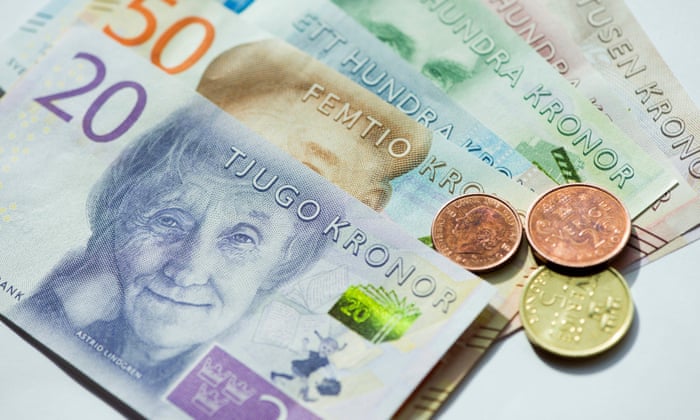
In 1661, Stockholms Banco, the precursor to the Swedish central bank, issued Europe’s first banknotes, on thick watermarked paper bearing the bank’s seal and eight handwritten signatures.
Last year – as Britain did last week – Sweden launched a new series of notes, cheery affairs featuring 20th-century Swedish cultural giants such as Astrid Lindgren, the creator of Pippi Longstocking, Greta Garbo and filmmaker Ingmar Bergman. But like its Nordic neighbours Norway, Denmark and Finland, Sweden is fast becoming an almost entirely cashless society.
“I don’t use cash any more, for anything,” said Louise Henriksson, 26, a teaching assistant. “You just don’t need it. Shops don’t want it; lots of banks don’t even have it. Even for a candy bar or a paper, you use a card or phone.”
Swedish buses have not taken cash for years, it is impossible to buy a ticket on the Stockholm metro with cash, retailers are legally entitled to refuse coins and notes, and street vendors – and even churches – increasingly prefer card or phone payments.
According to central bank the Riksbank, cash transactions made up barely 2% of the value of all payments made in Sweden last year – a figure some see dropping to 0.5% by 2020. In shops, cash is now used for barely 20% of transactions, half the number five years ago, and way below the global average of 75%.
And astonishingly, about 900 of Sweden’s 1,600 bank branches no longer keep cash on hand or take cash deposits – and many, especially in rural areas, no longer have ATMs. Circulation of Swedish krona has fallen from around 106bn in 2009 to 80bn last year.
“I think, in practice, Sweden will pretty much be a cashless society within about five years,” said Niklas Arvidsson, an associate professor specialising in payment systems innovation at Stockholm’s Royal Institute of Technology (KTH).
more here:
https://www.theguardian.com/business/2016/jun/04/sweden-cashless-society-cards-phone-apps-leading-europe
=========================================================================
A last hurrah for banknotes as UK switches to mobile and card payment
With the launch of the new plastic fiver, Patrick Collinson looks at changing payment methods and asks if Britain is ready to become a cashless society
Patrick Collinson
Saturday 4 June 2016 11.00 EDT
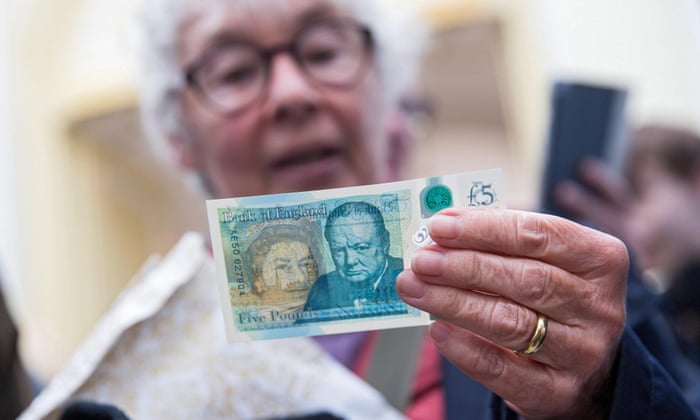
Winston Churchill gazes out from one side of the new £5 plastic note, the Queen from the other. But the chances of Prince William appearing on a banknote are looking slim. More than 300 years after the first Bank of England banknotes appeared, the new plastic ones could perhaps be the last.
Stop a young adult on a British high street and you will find that one in eight has not a penny in cash on them. Even the ones who do are likely to have no more than £20. For them, the cashless society is not tomorrow’s world, but today’s: a contactless card flashed to enter the tube; a smartphone tapped at Pret for a lunchtime sandwich; another card waved at a Tesco Express on the way home; the cab journey back from the pub processed by Uber.
Who needs banknotes? According to a survey by payments company Worldpay, six out of 10 young adults would prefer not to use cash at all.
When Transport for London banned cash on the buses in mid-2014, it was greeted with a backlash from some quarters; “passenger fury” said one headline, “ban hits the vulnerable” was another. Yet, two years on, behaviour has adjusted. TfL says it has saved £24m in cash-handling costs, and queues have improved.
The cashless society has been long mooted, but only now is it arriving. A 1996 trial in Swindon to encourage the town’s 150,000-plus people to use “electronic purses” flopped through lack of interest. But contactless cards – there are now more than 36m in Britain’s wallets – and more recently Apple Pay and Android Pay, have dramatically accelerated the switch away from cash.
Crucially, it has been the readiness of big retailers to accept “tap-and-go” technology for small-value items, with Tesco and TfL at the forefront, that has spurred the revolution. Monthly spending on contactless cards is now running at around £1.5bn, or three times the level of just a year ago.
Technology experts see contactless payment as just a stepping stone to the cashless society, with smartphones becoming the main way to pay. Since the launch of Apple Pay in July last year, 8 million journeys on London Underground have been paid for by iPhone users tapping their handset at entry and exit points. Meanwhile, Google’s rival, Android Pay, was launched last month. Unlike contactless cards, where spending is capped at £30, Apple and Android users can spend more freely, although they may have to authenticate with a Pin or fingerprint.
more here:
https://www.theguardian.com/business/2016/jun/04/uk-switch-to-cashless-society-contactless-payment
=========================================================================
The Countries That Would Profit Most from a Cashless World
Bhaskar ChakravortiRavi Shankar ChaturvediBenjamin Mazzotta
MAY 31, 2016
It’s been nearly 300 years since paper money became accepted as legal tender. While much has changed about how we make, sell, and buy goods, cash has stuck around. It’s been only recently that the road to a wider cashless society has started to really take shape. From apps such as PayPal, Venmo, or Square Cash to mobile payment platforms like Kenya’s mPesa, Bangladesh’s bKash, or Apple Pay, there are signs that cash is following the path of other “information goods,” such as printed photographs, cassette tapes, and DVDs in being replaced by digital alternatives.
Or as Samantha Bee, host of the show Full Frontal, put it recently: “I’d like to talk a little bit about money. For those of you who haven’t heard of it, it’s like Venmo for old people.”
But all of this may still leave us with a question – if cash isn’t inherently broken, why fix it?
Policy makers and economists, such as Harvard’s Ken Rogoff, have made elegant arguments for the benefits of a cashless society. Economic uncertainty around the globe has raised concerns that consumers could take cash out of banks – especially in negative interest rate envrionments — and hoard it. Eliminating cash is one way to reduce that risk. Denmark, Sweden, and Norway are already considering it, while the European Central Bank is considering getting rid of large-denomination bills.
Cash, according to a recent MasterCard study, accounts for nearly 85% of global consumer transactions. Cash has stubbornly resisted going the way of digital extinction. Paper currency is ubiquitous. It is also untraceable and universally accepted (except in some circumstances, usually involving very large payments). For many users, cash equates to a sense of security and for many it is a sense of independence from government oversight. The rise of cyber-crime and growing concerns about the ability of public agencies to look through digital records will add to the unwillingness among many to let go of paper money.
The migration to a cashless society is far from being either uniform or universal. Whereas most Swedes are embracing a cashless future, along with an unlikely peer group, that includes both Somaliland and South Korea, some of Sweden’s neighbors, in response to EU’s increasing regulations on restricting cash usage, are demanding a “constitutional right to pay in cash” fueled by concerns around negative interest rates and a perceived loss of privacy that comes with digital money.
more here:
https://hbr.org/2016/05/the-countries-that-would-profit-most-from-a-cashless-world
=========================================================================
-Spyda
Wednesday, June 1, 2016
The CFR Speaks: "America is ALREADY great" -Fareed Zakaria
Fareed's Take: America is ALREADY great
While Donald Trump wants to "make America great again," Fareed argues it still is the world's leading economic, technological, military and political power.
Video here:
http://www.cnn.com/videos/tv/2016/06/01/exp-gps-0529-take-trump.cnn
I've written before about Fareed Zakaria.
This video here from 2012 covers the deception of nostalgia:
Don't let the idea of Trump sucker you into a false sense of security.
He won't be president in the coming Kingdom of God.
-Spyda
Tuesday, May 31, 2016
Foward Thinking: How Megacities Are Changing the World
Forward Thinking: How Megacities Are Changing the World
Millions of people every year swell the planet's cities. How do we harness the economic potential of these powerful hubs?
JamesHertling | May 27, 2016 — 3:55 AM CDT
We live in the age of the megacity.
For the first time in human history more people now live in urban settlements than in rural ones, and those urban locales are growing ever bigger. Every year, Lagos, Africa's biggest city, grows by the population of Boston.
Within 10 years, about two-thirds of the world's gross domestic product will be generated by cities, up from about half now.
Most of that growth will come from the emerging world, especially China and India, meaning the stakes to get growth and development right are increasing rapidly.
The challenges range from ensuring clean streets to confronting the impact of climate change. In Rio de Janeiro, the military roams the streets to crack down on crime; in Lagos, policy makers who have often left residents to their own devices now have to introduce governance without wrecking structures developed over the years.
Then there's the massive seawall for Jakarta to ensure the city's not swamped by rising seas and metro lines being planned for all over India and the race to put up affordable housing in London.
From mayors and local councilors to presidents and prime ministers, getting cities right is more than a local and national question – it's one for all of us.
video here:
http://www.bloomberg.com/news/articles/2016-05-27/forward-thinking-how-megacities-are-changing-the-world
Millions of people every year swell the planet's cities. How do we harness the economic potential of these powerful hubs?
JamesHertling | May 27, 2016 — 3:55 AM CDT
We live in the age of the megacity.
For the first time in human history more people now live in urban settlements than in rural ones, and those urban locales are growing ever bigger. Every year, Lagos, Africa's biggest city, grows by the population of Boston.
Within 10 years, about two-thirds of the world's gross domestic product will be generated by cities, up from about half now.
Most of that growth will come from the emerging world, especially China and India, meaning the stakes to get growth and development right are increasing rapidly.
The challenges range from ensuring clean streets to confronting the impact of climate change. In Rio de Janeiro, the military roams the streets to crack down on crime; in Lagos, policy makers who have often left residents to their own devices now have to introduce governance without wrecking structures developed over the years.
Then there's the massive seawall for Jakarta to ensure the city's not swamped by rising seas and metro lines being planned for all over India and the race to put up affordable housing in London.
From mayors and local councilors to presidents and prime ministers, getting cities right is more than a local and national question – it's one for all of us.
video here:
http://www.bloomberg.com/news/articles/2016-05-27/forward-thinking-how-megacities-are-changing-the-world
TED Presentation on Megacities - 05.31.2016
"I want you to reimagine how life is organized on earth," says global strategist Parag Khanna. As our expanding cities grow ever more connected through transportation, energy and communications networks, we evolve from geography to what he calls "connectography." This emerging global network civilization holds the promise of reducing pollution and inequality — and even overcoming geopolitical rivalries. In this talk, Khanna asks us to embrace a new maxim for the future: "Connectivity is destiny."
video here:
How megacities are changing the map of the world | Parag Khanna
Published on Apr 27, 2016
You see, while people focus on secession, The Agenda moves forward.
-Spyda
video here:
How megacities are changing the map of the world | Parag Khanna
Published on Apr 27, 2016
You see, while people focus on secession, The Agenda moves forward.
-Spyda
Monday, May 23, 2016
Cashless Society Update: If I put a chip in my own hand, is that The Mark of the Beast?
After watching that you're probably thinking...
"Oh Lord Jesus, it's The Mark of the Beast!"
Well, it's close:
Revelation of John 13:15-17
15 And he had power to give life unto the image of the beast, that the image of the beast should both speak, and cause that as many as would not worship the image of the beast should be killed.
16 And he causeth all, both small and great, rich and poor, free and bond, to receive a mark in their right hand, or in their foreheads:
17 And that no man might buy or sell, save he that had the mark, or the name of the beast, or the number of his name.
We'll know it's the Mark when we see two things happen:
1) The Beast has to be here for this to qualify as The Mark. At the moment, no one has come forward to make that claim.
2) The Mark will be deployed Globally. currently very few people are actually using RFID in their hand to buy items at stores. As a matter of fact it's such a small number of people you don't know anyone in your life doing that right now.
So relax. It's just one more step.
-Spyda
Subscribe to:
Posts (Atom)